
Affiliate Disclosure: SmartSpaceAdvisor.com is a participant in the Amazon Services LLC Associates Program. We may earn a commission when you buy through our links at no extra cost to you. Our recommendations are always based on honest research — never paid placements.
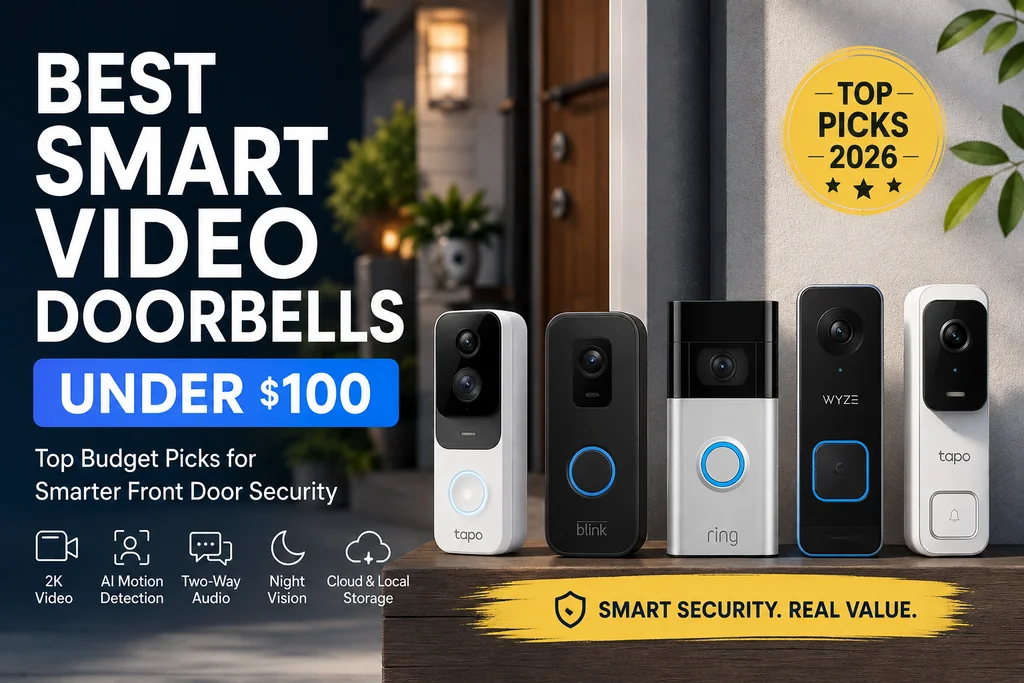
A good video doorbell doesn’t need to cost $200 or more.
For under $100, you can now get features that were once reserved for premium doorbells: 2K video, person detection, two-way talk, wide-angle views, night vision, rechargeable batteries, local storage, and smart-home integration.
The catch is that budget doorbells aren’t all equally good. Some offer excellent hardware but push you toward a monthly cloud subscription. Others provide free local recording but make compromises in video quality, app experience, or smart-home compatibility.
That’s why the price tag shouldn’t be the only thing you compare.
We looked at the features that matter most for a front-door camera—video quality, field of view, motion detection, storage, subscription requirements, battery life, installation, smart-home compatibility, and overall value—to identify the budget models worth considering in 2026.
Our Top Picks at a Glance
| Image | Product | Rating | Price |
|
1
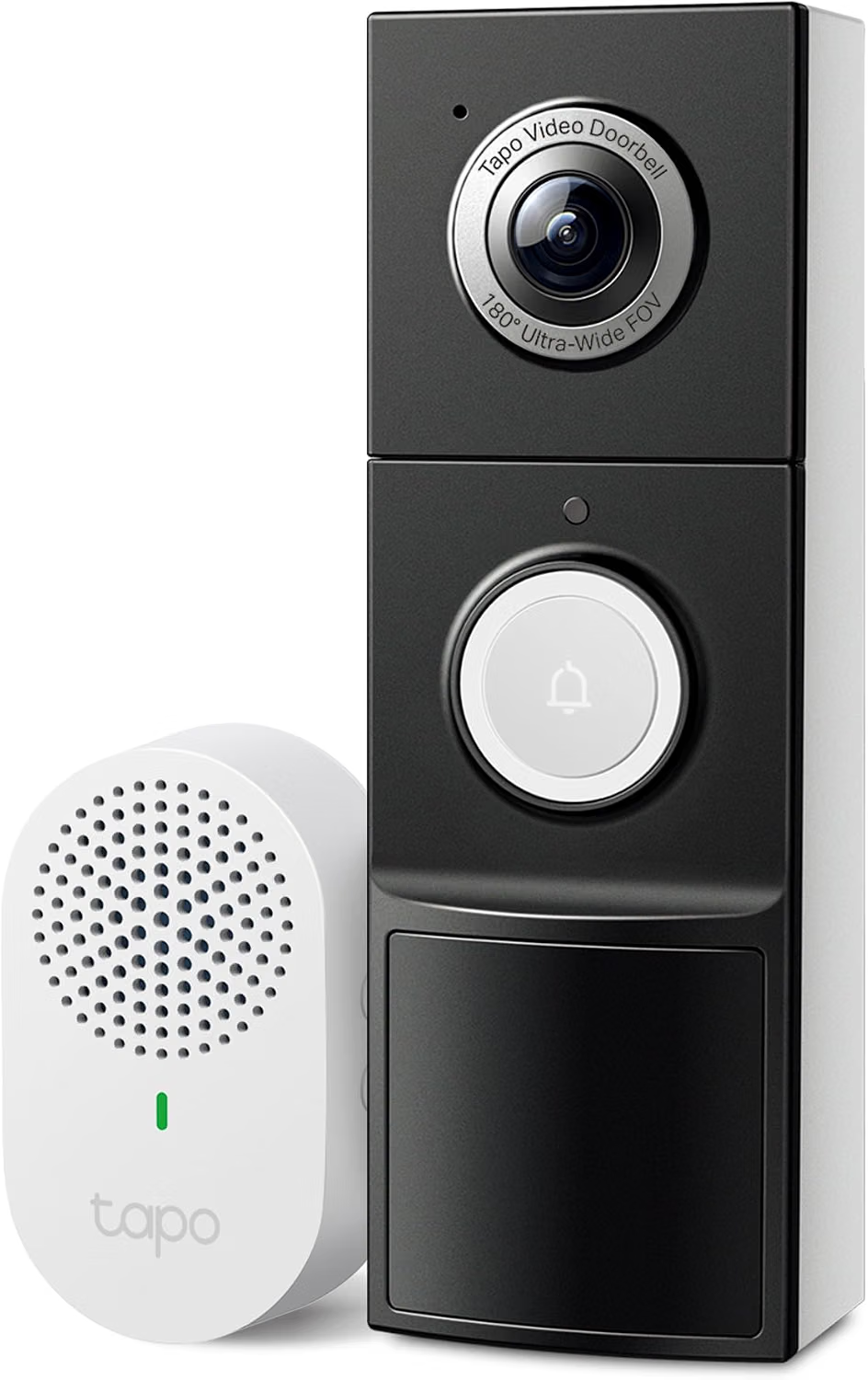 |
TP-Link Tapo D225 Best overall |
9.4
|
$99.99
|
|
2
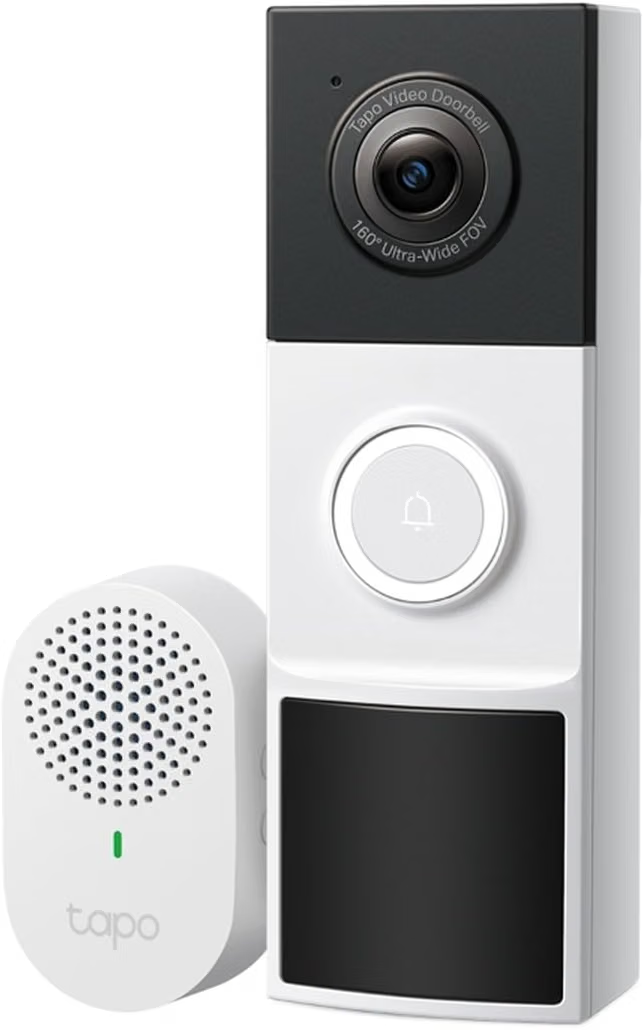 |
TP-Link Tapo D210 Best affordable 2K option |
9.1
|
$58.00
|
|
3
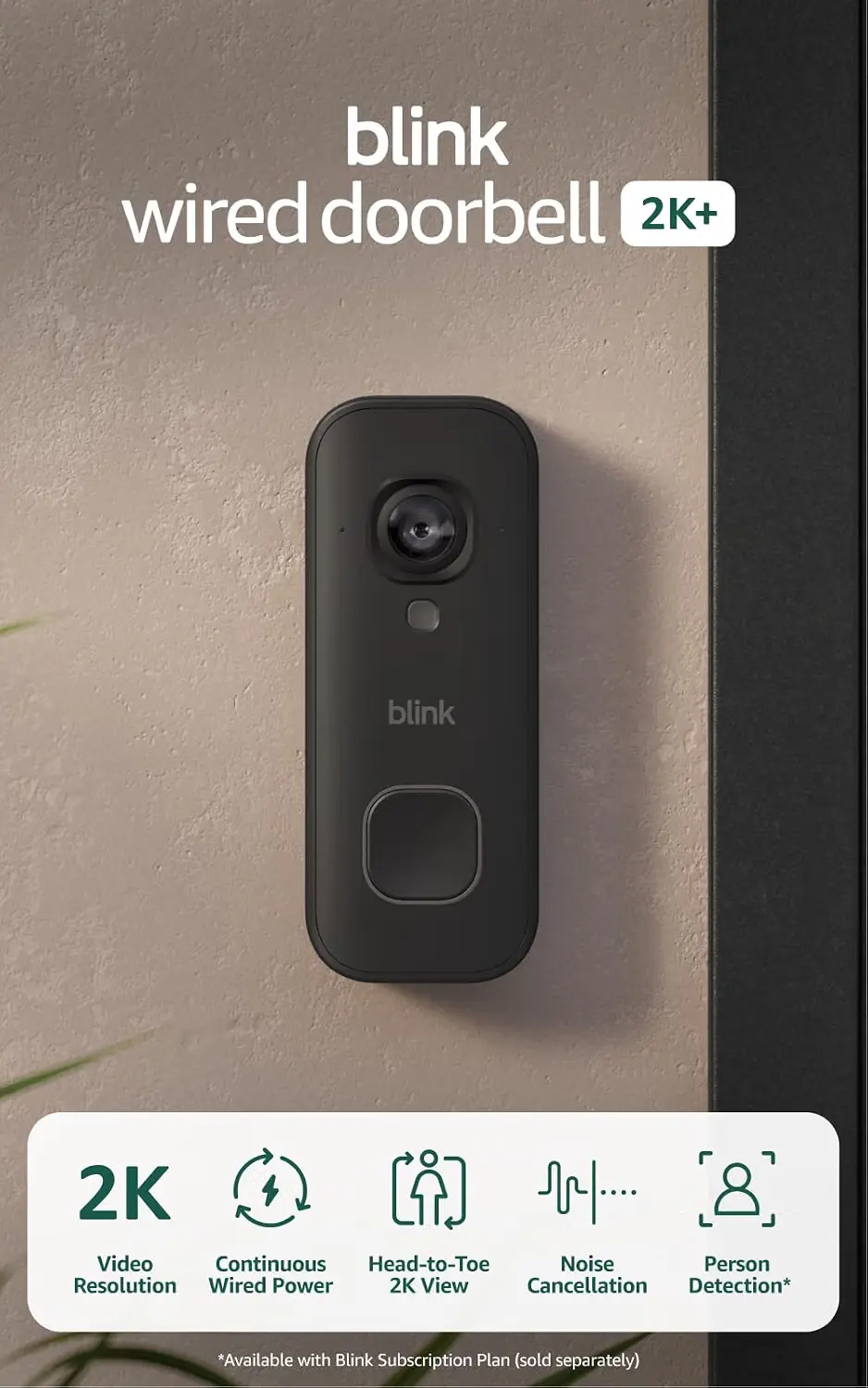 |
Blink Video Doorbell Best for Alexa households |
8.6
|
$59.99
|
|
4
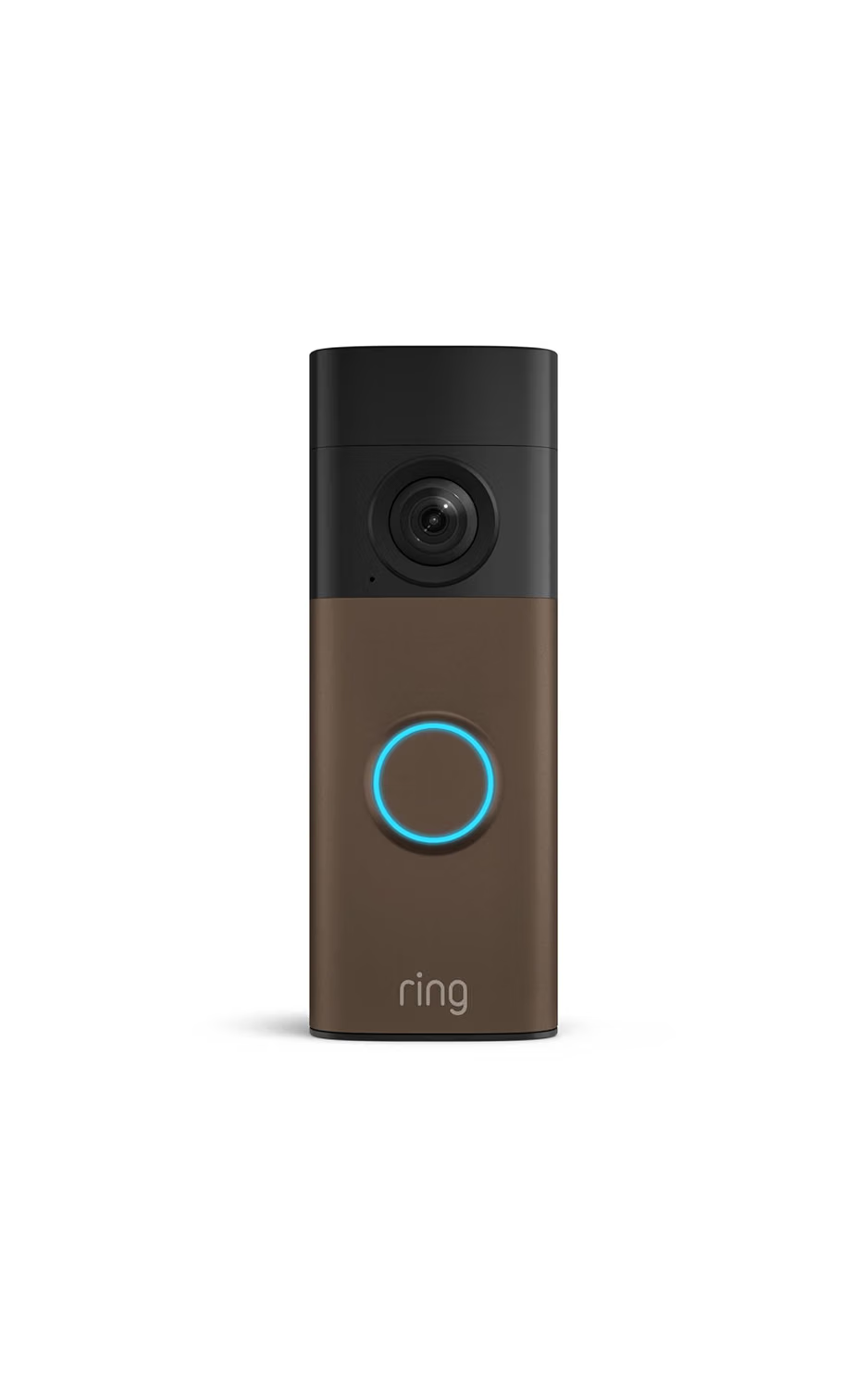 |
Ring Battery Doorbell Best for simple Ring integration |
8.5
|
$69.99
|
|
5
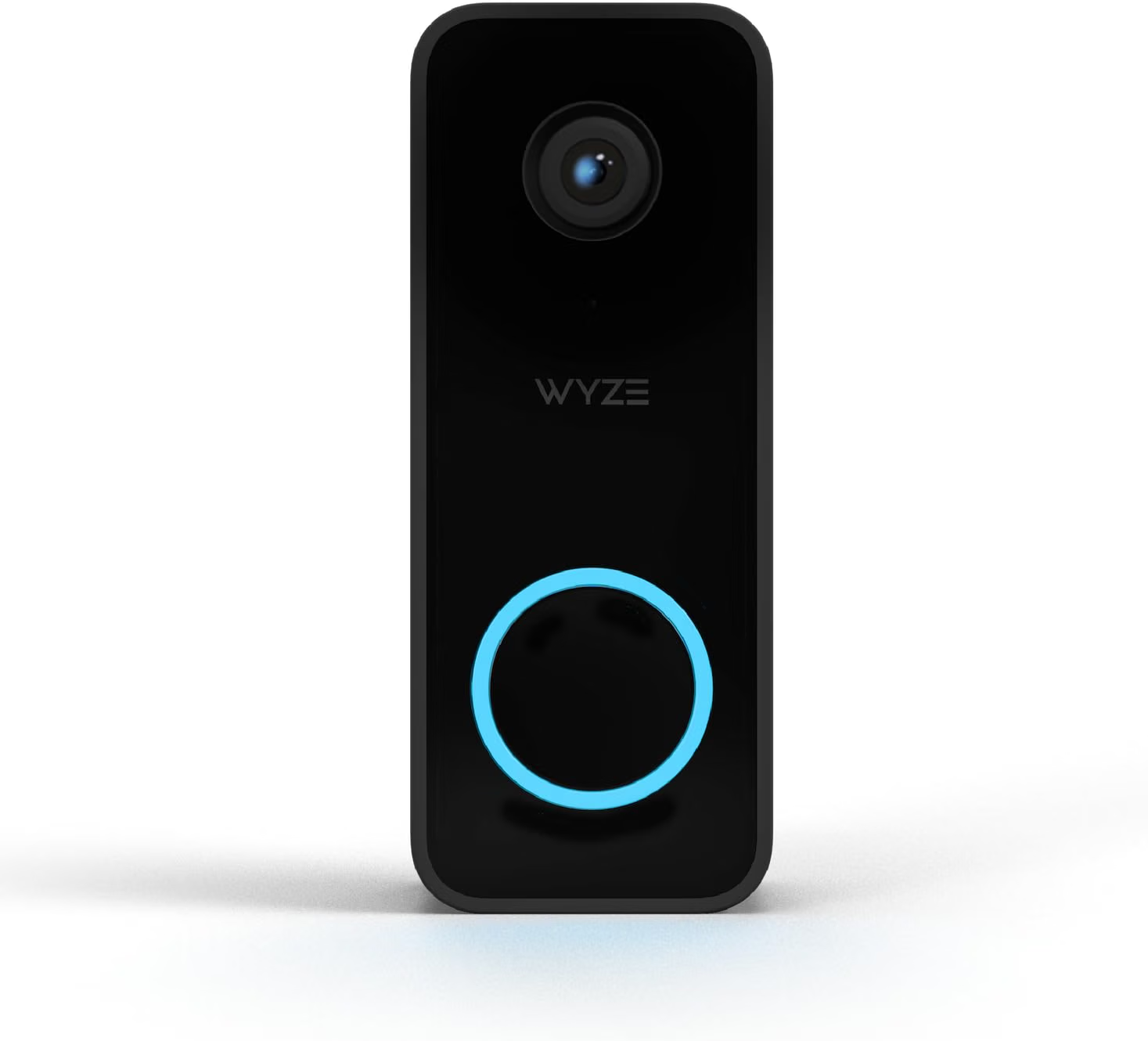 |
Wyze Video Doorbell v2 Best for budget-conscious smart-home users |
8.5
|
$59.98
|
Our top pick: The Tapo D225 stands out because it combines 2K video, an expansive 180-degree view, battery or wired operation, local microSD storage, AI detection, color night vision, and optional 24/7 recording when hardwired. TP-Link currently lists it at $99.99, although prices can change.
Best Smart Video Doorbells Under $100: Quick Comparison
|
TP-Link Tapo D225 |
TP-Link Tapo D210 |
Blink Video Doorbell |
Ring Battery Doorbell |
Wyze Video Doorbell v2 |
|
|---|---|---|---|---|---|
| Video | 2K QHD | 2K | HD | HD | 2K |
| Power | Battery/Wired | Battery | Power: Battery; optional chime wiring | Battery | Wired |
| Storage | microSD/Cloud | microSD/Cloud | Cloud/Sync Module | Cloud | Local/Cloud options |
| AI Detection | Person, Pet, Vehicle, Package | Person | Motion/person features vary | Motion detection | Smart detection |
| Field of View | 180° | 160° | Wide view | Head-to-toe view | Wide view |
Specifications and pricing can vary by model, region, bundle, and retailer. Always verify the current listing before purchasing.
1. TP-Link Tapo D225 — Best Smart Video Doorbell Under $100
- Sharp 2K QHD video
- 180-degree head-to-toe field of view
- Battery or hardwired installation
- Up to eight months of claimed battery life
- Local microSD storage up to 512GB
- Person, pet, vehicle, and package detection
- Color night vision
- Two-way audio
- Activity zones
- Up to four seconds of pre-roll
- 24/7 recording when hardwired
- Indoor chime included
- Some of its most advanced recording features depend on wired installation
- microSD card is purchased separately
- Cloud storage requires Tapo Care
- Battery life will vary substantially with usage
Video Quality
The D225 records at 2K QHD, giving it considerably more detail than basic 1080p doorbells.
Its 180-degree view is another major advantage. The wider perspective is designed to capture visitors and deliveries from head to toe rather than concentrating only on a person’s face.
Storage and Subscription
This is one of the strongest reasons to consider the D225.
You can install a microSD card of up to 512GB and store recordings locally without paying for cloud storage. TP-Link also offers Tapo Care for users who want cloud-based storage and additional services.
For buyers trying to keep long-term ownership costs low, local storage is a significant advantage.
Battery Life
TP-Link rates the rechargeable battery for up to eight months, although actual battery life depends on settings, recording activity, live viewing, Wi-Fi conditions, and other factors.
Our Verdict
SmartSpaceAdvisor Score: 9.4/10
The D225 offers an unusually complete feature set for a sub-$100 doorbell. Its combination of 2K video, wide coverage, local storage, AI detection, flexible power, and color night vision makes it the best overall smart video doorbell under $100 for most buyers.
2. TP-Link Tapo D210 — Best Value
- 2K video
- 160-degree
- Field of view
- Rechargeable battery
- Up to six months of claimed battery life
- Person detection
- Color night vision
- Local microSD storage
- Two-way audio
- Activity zones
-
Alexa and Google Assistant compatibility
- Less advanced detection than the D225
- No 24/7 wired recording
- Battery performance depends on usage
- microSD card is sold separately
Storage
One of the D210’s biggest advantages is that you can use a microSD card for local recordings without paying a monthly cloud-storage fee. TP-Link says it supports cards up to 512GB.
Battery Life
TP-Link rates the rechargeable battery for up to 180 days, although real-world performance varies depending on how often the doorbell detects motion and how frequently you view live video.
Our Verdict
SmartSpaceAdvisor Score: 9.1/10
If you want 2K video and local storage without spending as much as premium doorbells, the Tapo D210 is one of the strongest values in this category.
3. Blink Video Doorbell — Best for Alexa Users
- Affordable
- Simple installation
- Battery-powered, with optional connection to existing chime wiring
- HD video
- Two-way audio
- Motion notifications
- Alexa integration
- Long battery life on compatible configurations
- Video resolution isn’t as impressive as some 2K competitors
- Advanced recording features can involve additional hardware or subscriptions
- Local storage requires compatible Blink hardware
- Feature set depends on the configuration you purchase
Who Should Buy It?
The Blink Video Doorbell makes the most sense for someone who wants a simple, inexpensive smart doorbell and already uses Alexa.
If maximum image quality and local storage are your priorities, however, Tapo’s 2K models are more compelling.
Our Verdict
SmartSpaceAdvisor Score: 8.6/10
A good choice for Alexa households that prioritize simplicity and affordability over having the most advanced camera hardware
4. Ring Battery Doorbell — Best for Ring Users
- Simple wireless installation
- Two-way talk
- Motion alerts
- Live video
- Rechargeable battery
- Alexa integration
- Strong Ring ecosystem
- Easy expansion if you already own Ring device
- Cloud features can increase the long-term cost
- Local-storage flexibility isn’t as strong as some Tapo alternatives
- Budget Ring models generally don’t offer the same resolution/value combination as some competitors
Who Should Buy It?
Buy the Ring Battery Doorbell if ecosystem compatibility is more important to you than getting the maximum number of features for your money.
For someone starting from scratch, I’d compare it carefully against Tapo and Wyze before buying.
Our Verdict
SmartSpaceAdvisor Score: 8.5/10
A solid choice for Ring/Alexa households, particularly if you already own other Ring hardware.
5. Wyze Video Doorbell v2 — Best Feature Value
- 2K video
- Competitive price
- Compact design
- Smart alerts
- Two-way audio
- Wyze ecosystem integration
- Strong feature-to-price ratio
- Subscription considerations
- Smart-home ecosystem is narrower than some major competitors
- Availability and pricing can vary
- App experience may not appeal to everyone
Who Should Buy It?
The Wyze Video Doorbell v2 is a good choice if your priority is getting a lot of camera hardware and smart features for relatively little money.
It’s especially attractive if you already have Wyze cameras or sensors.
Our Verdict
SmartSpaceAdvisor Score: 8.5/10
A compelling budget choice, particularly for existing Wyze users.
What Should You Look For in a Video Doorbell Under $100?
Buying the cheapest doorbell isn’t necessarily the best way to save money.
A $50 doorbell that requires an expensive subscription can ultimately cost more than a $90 doorbell with local storage.
Here are the specifications that matter most.
2K vs. 1080p Video
Resolution matters because the doorbell needs to capture details at a distance.
A 1080p camera can be perfectly adequate for general monitoring, but 2K provides more pixels to work with, which can help when identifying faces, packages, clothing, or other details.
For a front door, I’d choose 2K whenever the price difference is small.
Field of View
A wide field of view is particularly important for doorbells.
You don’t just want to see someone’s face.
You also want to see:
- Packages
- The person’s hands
- The area immediately around the door
- Visitors standing close to the camera
- People approaching from the side
A doorbell such as the Tapo D225 goes particularly far here, with a claimed 180-degree view.
Wired vs Wire-Free: Which Installation Type Fits Your Home?
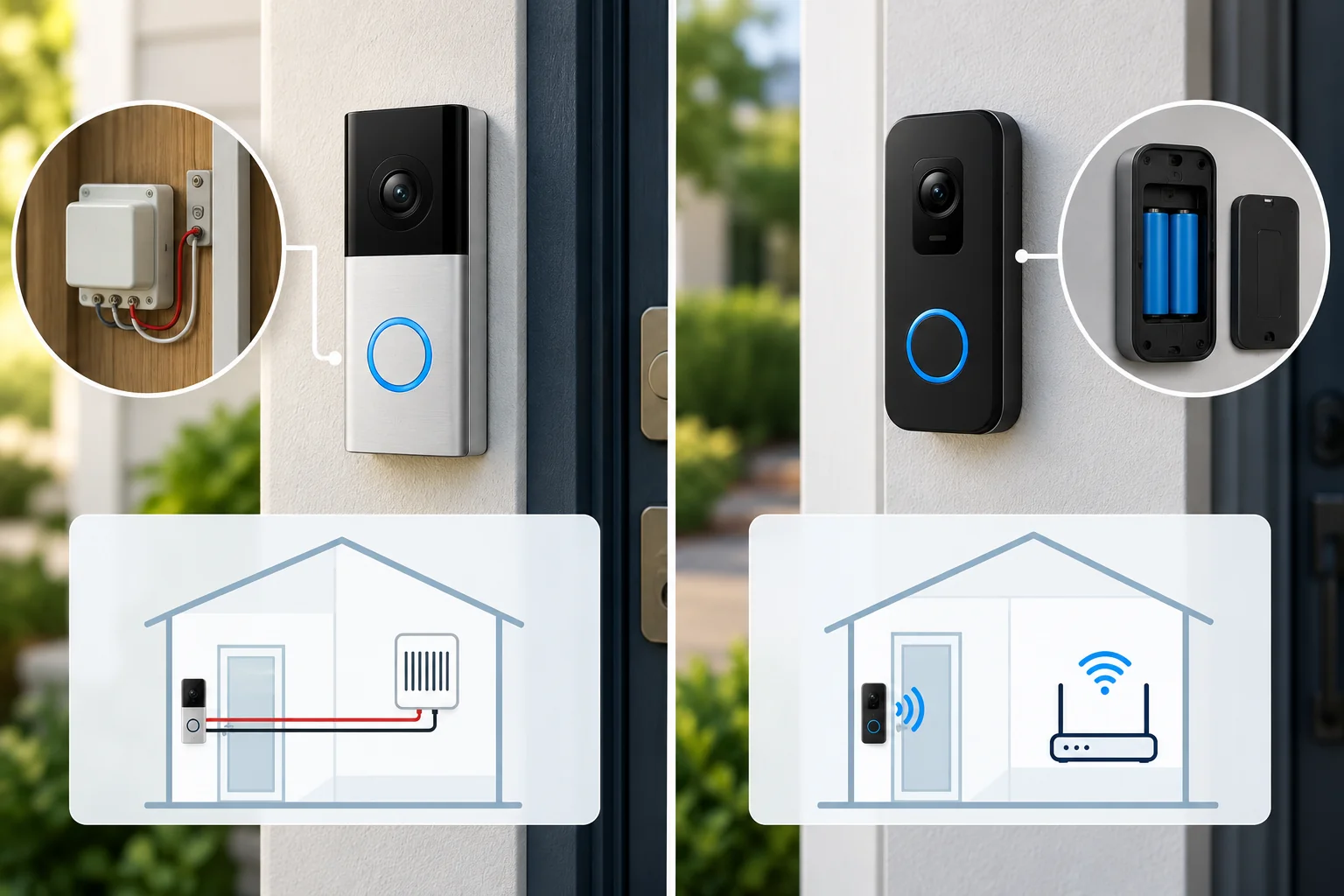
Choose wired if:
- You have existing doorbell wiring (most homes built before smart doorbells became common)
- You never want to think about battery charging
- You’re willing to do (or hire) a short wiring installation
Choose wire-free (battery) if:
- You’re renting and can’t modify existing wiring
- Your home has no existing doorbell circuit
- You’re comfortable recharging or replacing batteries every few months to two years, depending on the model
Some doorbells, including the Tapo D225, give you both options.
Do You Need a Subscription?
Not necessarily.
This is one of the most important things to check before buying a budget doorbell.
There are three common approaches.
Cloud subscription
Your video is stored remotely.
Advantages:
- Easy remote access
- No memory card required
- Usually convenient
Disadvantages:
- Recurring cost
- Some features may be locked behind the subscription
Local storage
Video is stored on a microSD card or another local device.
Advantages:
- No monthly storage fee
- More control over recordings
- Lower long-term cost
Disadvantages:
- You need to buy/manage storage
- If the camera is stolen, local footage may potentially be lost depending on the design
The Tapo D225 and D210 support microSD storage up to 512GB, giving them a major advantage for buyers who want to minimize recurring fees.
Hybrid storage
Some doorbells let you choose between local and cloud storage.
For most buyers, hybrid is the most flexible option.
Person Detection Is More Important Than It Sounds
Cheap doorbells can generate a lot of notifications.
A tree moves.
A car passes.
A cat walks across the driveway.
Someone approaches the sidewalk.
Your phone buzzes.
Then you discover that nothing important happened.
That’s why AI-powered detection can be more useful than simply having a high-resolution camera.
Instead of notifying you about every movement, compatible doorbells can distinguish between categories such as people, packages, pets, and vehicles.
For example, the Tapo D225 supports person, pet, vehicle, and package detection without requiring a subscription for those AI alerts.
Night Vision Matters
A doorbell that looks great at noon but produces unusable footage at night isn’t much help for security.
Look for:
- Infrared night vision
- Color night vision
- Built-in illumination
- HDR/WDR
- Good low-light performance
Color night vision can be particularly useful because it preserves information such as clothing and vehicle color.
The Tapo D225 uses built-in spotlights for full-color night vision.
Smart-Home Compatibility
Before buying, check which ecosystem you use.
Amazon Alexa
Blink and Ring are obvious choices if your home revolves around Alexa, while Tapo also supports Alexa integration on compatible devices.
Google Home
Tapo’s doorbell lineup can integrate with Google Assistant/Google Home-compatible setups.
Apple HomeKit
This is where things become more complicated.
Don’t assume that a doorbell supporting Alexa or Google automatically supports Apple Home.
If Apple Home compatibility is essential, verify the exact model, not simply the manufacturer’s brand.
How We Evaluate Budget Video Doorbells
A good doorbell review shouldn’t be based solely on specifications.
For SmartSpaceAdvisor, we recommend evaluating every doorbell across these categories:
Video quality — 25%
Resolution, HDR/WDR, sharpness and night performance.
Detection and alerts — 20%
Person detection, package detection, false alerts and activity zones.
Storage and subscription costs — 15%
Local storage, cloud options and long-term ownership costs.
Smart-home compatibility — 10%
Alexa, Google Home, Matter and other supported ecosystems.
Installation and power — 10%
Battery life, wiring requirements and installation flexibility.
App experience — 10%
Live view, notifications, playback and settings.
Value — 10%
What you actually get for the purchase price.
This is important because the best budget doorbell isn’t necessarily the cheapest one.
Which Smart Video Doorbell Should You Buy?
Buy the Tapo D225 if…
You want the best overall combination of video quality, smart detection, local storage, wide-angle coverage and flexible power.
Buy the Tapo D210 if…
You want 2K video and local storage at a lower price and don’t need the D225’s more advanced features.
Buy the Blink Video Doorbell if…
You already have an Alexa-based smart home and want a straightforward, inexpensive doorbell.
Buy the Ring Battery Doorbell if…
You’re already invested in the Ring ecosystem and want another doorbell that integrates naturally with your existing setup.
Buy the Wyze Video Doorbell v2 if…
You want strong hardware and features for the money, particularly if you already use Wyze products.
Frequently Asked Questions
What is the best smart video doorbell under $100?
For most shoppers, the TP-Link Tapo D225 is our top choice. It combines 2K video, a 180-degree field of view, battery or wired operation, local microSD storage, AI detection, color night vision and two-way audio.
Is a $100 video doorbell good enough for home security?
Yes. A sub-$100 doorbell can provide the essential features most households need, including motion detection, live video, two-way audio and smartphone notifications. The main compromises compared with premium models are usually advanced AI, image quality, storage options and ecosystem features.
Do video doorbells require Wi-Fi?
Most smart video doorbells require Wi-Fi to send notifications, provide remote live viewing and communicate with their mobile apps.
Is 2K better than 1080p for a doorbell?
Generally, yes. 2K provides greater image detail than 1080p and can be useful for identifying people and packages. However, resolution isn’t everything. Lens quality, lighting, HDR, compression and field of view also affect real-world image quality.
Can I use a video doorbell without a subscription?
Yes, depending on the model. Doorbells that support local microSD storage can allow you to record footage without paying for cloud storage. For example, Tapo’s D210 and D225 support local microSD storage up to 512GB.
Are battery-powered doorbells worth it?
Yes, especially if you don’t have existing doorbell wiring. They’re easier to install and provide much more flexibility. The trade-off is that you’ll eventually need to recharge the battery.
How long do video doorbell batteries last?
Manufacturers often advertise several months of battery life, but actual performance varies considerably. Motion frequency, live viewing, recording settings, Wi-Fi quality, temperature and other factors can all affect battery life.
Final Verdict
You don’t have to spend several hundred dollars to get a capable smart video doorbell.
The TP-Link Tapo D225 is our favorite option under $100 because it offers an unusually complete package: 2K video, 180-degree coverage, battery or wired power, local storage, smart AI detection, color night vision and two-way audio. TP-Link also supports 24/7 continuous recording when the D225 is hardwired.
If you want to spend less, the Tapo D210 is an excellent value alternative, particularly because it combines 2K video with local storage and a rechargeable battery.
For Alexa-focused homes, Blink remains worth considering, while existing Ring users may prefer the Ring Battery Doorbell simply because of the ecosystem advantages.
The biggest lesson is this: don’t judge a $100 doorbell by its purchase price alone. Check its storage policy, subscription requirements, battery expectations, AI detection, smart-home compatibility and video quality before buying.
A doorbell that costs $70 but requires a recurring subscription may not be a better deal than a $90 model that lets you store footage locally.
For most homeowners, 2K video + reliable motion/person detection + local storage + good night vision is the sweet spot.
Our overall pick: TP-Link Tapo D225.

Ryan Hayes
Founder & EditorRyan Hayes is the founder and editor of Smart Space Advisor, where he researches and evaluates smart home technology to help readers make informed buying decisions. His work focuses on smart security, video doorbells, smart plugs, lighting, and connected-home platforms including Matter, Alexa, Google Home, and Apple Home. By combining product research, manufacturer documentation, feature comparisons, and real-world considerations, Ryan aims to cut through technical jargon and provide practical, straightforward advice about which smart home products offer genuine value.