
Affiliate Disclosure: SmartSpaceAdvisor.com is a participant in the Amazon Services LLC Associates Program. We may earn a commission when you buy through our links at no extra cost to you. Our recommendations are always based on honest research — never paid placements.
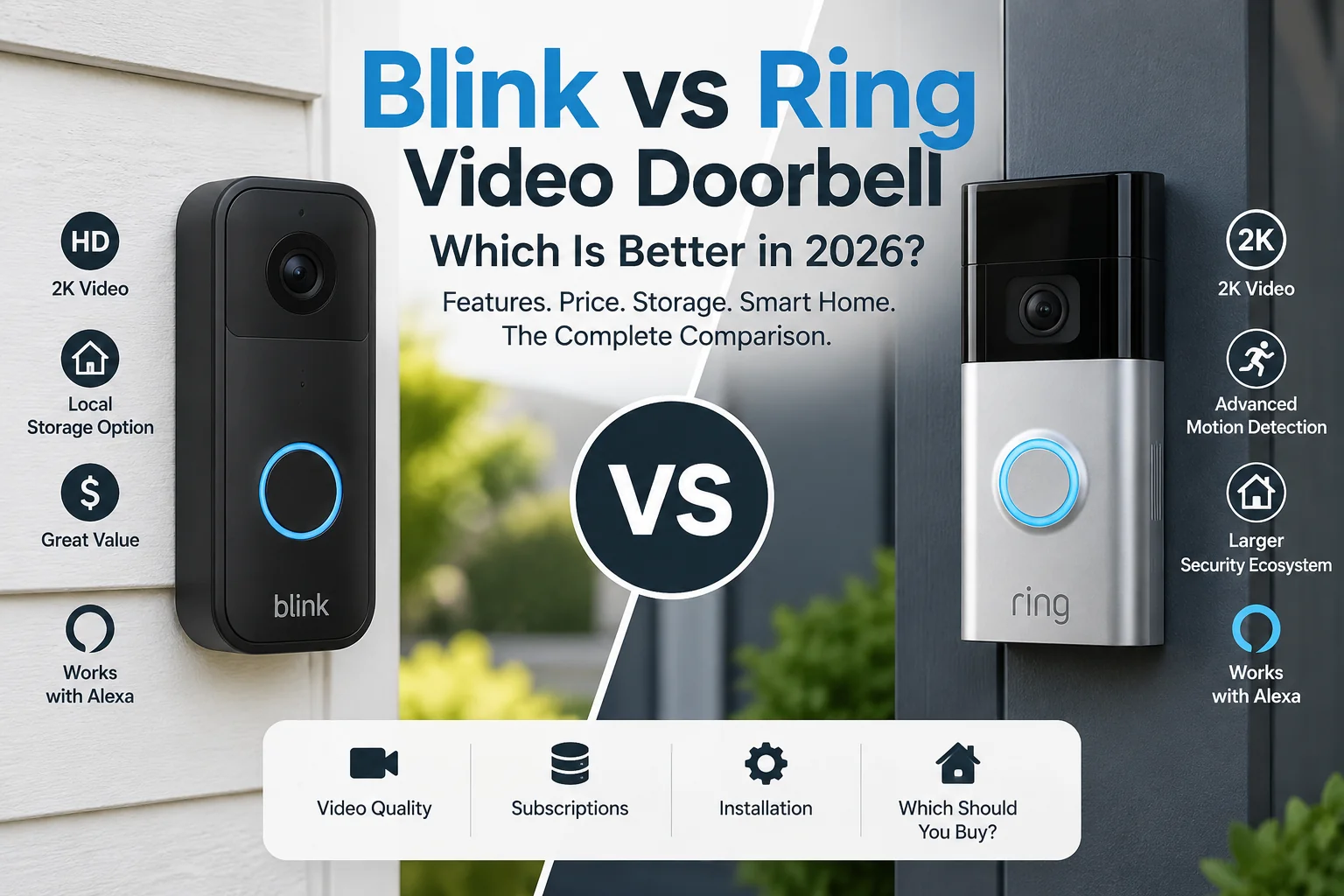
Blink and Ring are two of the biggest names in video doorbells—and they’re both owned by Amazon. But choosing between them isn’t as simple as picking the cheaper brand or the doorbell with the highest resolution.
In 2026, both lineups have changed significantly.
Blink now offers the Blink Wired Doorbell 2K+, Blink Battery Doorbell 2K+, and the more affordable Blink Video Doorbell (2nd Gen). Ring’s current lineup is broader, with models including the Ring Wired Doorbell 2K, Ring Wired Doorbell 2K Plus, Ring Battery Doorbell 2K Plus, and higher-end 4K options.
That makes this a much closer comparison than it used to be.
For most budget-conscious buyers, Blink offers better value and a stronger path to subscription-free local storage. Ring, however, offers the more sophisticated security ecosystem, more doorbell choices, better premium features, and stronger upgrade options.
So which brand—and more importantly, which specific model—should you buy?
Let’s compare them.
Blink vs Ring: Quick Verdict
If you’re looking for the short answer:
Choose Blink if you want to keep costs down, prefer the option of local video storage, already use Alexa, or simply need a reliable video doorbell without building an entire home-security system around it.
Choose Ring if you want more sophisticated motion detection, a broader selection of wired and battery doorbells, a larger security ecosystem, or plan to add cameras and other Ring security products later.
Our Winners
| Category | Winner |
|---|---|
| Best overall value | Blink |
| Best budget wired model | Blink Wired Doorbell 2K+ / Ring Wired Doorbell 2K |
| Best premium wired experience | Ring Wired Doorbell 2K Plus |
| Best battery experience | Ring Battery Doorbell 2K Plus |
| Best local storage option | Blink |
| Best without ongoing cloud storage | Blink |
| Best security ecosystem | Ring |
| Best motion detection | Ring |
| Best Alexa integration | Tie |
| Best selection of models | Ring |
| Best for renters | Ring |
| Best for budget-conscious homeowners | Blink |
The key is to compare equivalent models rather than treating every Blink and Ring doorbell as though they’re identical.
How we compared Blink and Ring
We compared the current 2026 video doorbell lineups using manufacturer specifications, subscription pricing, storage options, installation requirements, smart-home compatibility and the features that matter most when choosing a video doorbell. Prices and subscription terms can change, so we verify them against current manufacturer information.
Which Blink and Ring Doorbells Are We Comparing?
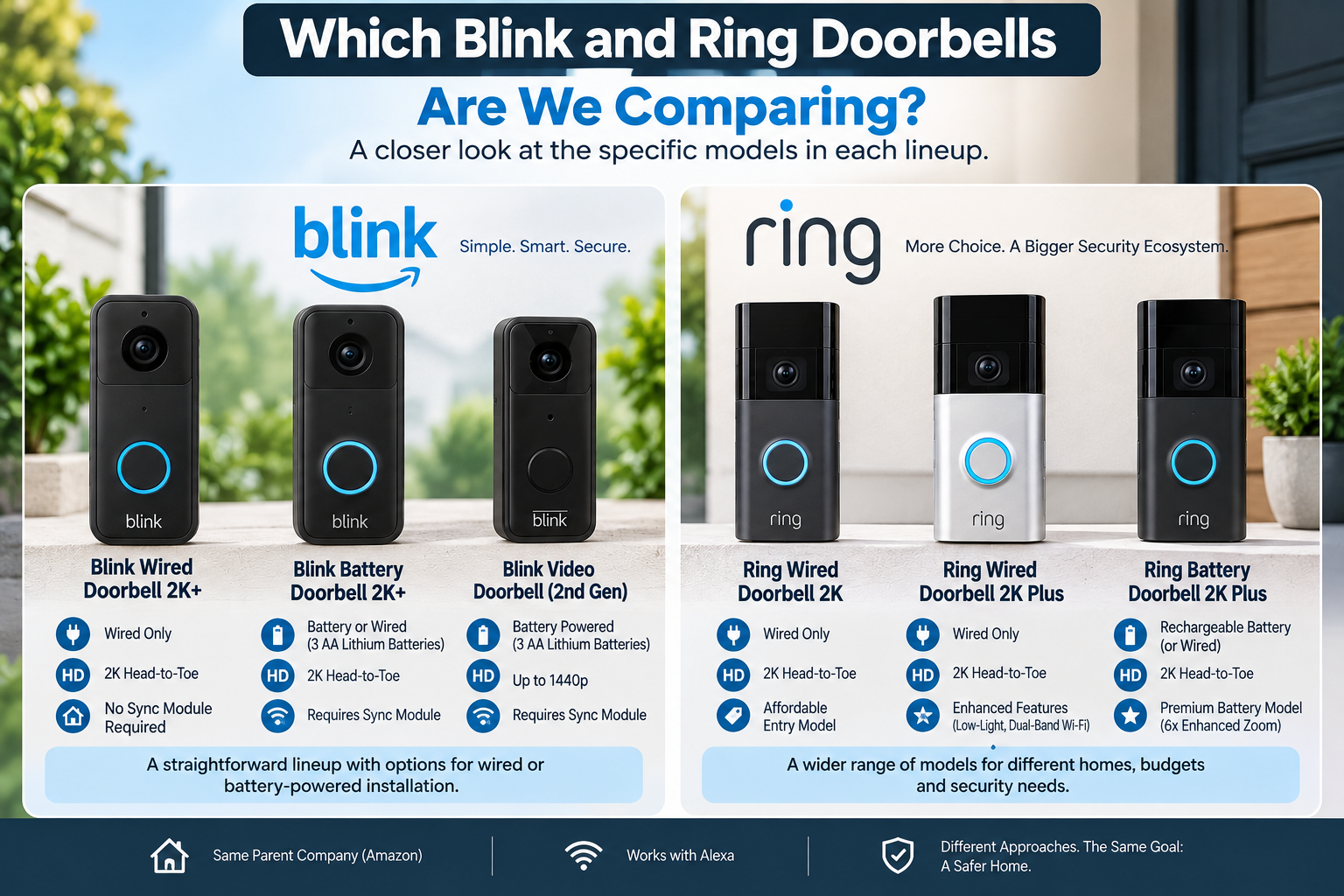
Blink has a relatively simple doorbell lineup. Ring gives buyers considerably more choice.
Current Blink Doorbells
Blink Wired Doorbell 2K+
A wired-only 2K doorbell aimed at homeowners with compatible existing wiring or a suitable power adapter. It records 1920 × 1920 video with a 1:1 head-to-toe view and does not require a Sync Module for basic operation.
Blink Battery Doorbell 2K+
Blink’s current battery-powered 2K model. It uses three AA lithium batteries, supports a 1:1 head-to-toe view, and can also be connected to compatible doorbell wiring. Unlike the Wired 2K+, it requires a Blink Sync Module.
Blink Video Doorbell (2nd Gen)
The cheaper step-down option. It records up to 1440p rather than 2K but still provides a square head-to-toe view. It also uses three AA lithium batteries and requires a Sync Module.
Current Ring Doorbells
Ring Wired Doorbell 2K
Ring’s affordable wired 2K model. It’s the closest price-oriented competitor to Blink’s Wired Doorbell 2K+ and brings 2K head-to-toe video into Ring’s lower-priced wired range.
Ring Wired Doorbell 2K Plus
A more premium wired model with 2K head-to-toe video, improved low-light capabilities, dual-band Wi-Fi, and more advanced motion technology.
Ring Battery Doorbell 2K Plus
A rechargeable battery model offering 2K head-to-toe video, up to 6x Enhanced Zoom, dual-band Wi-Fi, and a removable Quick Release Battery Pack.
The Models at a Glance
| Model | Video | Power | Best For |
|---|---|---|---|
| Blink Wired Doorbell 2K+ | 2K, 1:1 | Wired | Value-focused wired installation |
| Blink Battery Doorbell 2K+ | 2K, 1:1 | 3 AA lithium batteries | Blink users needing flexible installation |
| Blink Video Doorbell (2nd Gen) | Up to 1440p | 3 AA lithium batteries | Lower-cost Blink setup |
| Ring Wired Doorbell 2K | 2K head-to-toe | Wired | Affordable entry into Ring |
| Ring Wired Doorbell 2K Plus | 2K head-to-toe | Wired | Premium wired setup |
| Ring Battery Doorbell 2K Plus | 2K head-to-toe | Rechargeable battery | Flexible premium battery setup |
Throughout this comparison, we’ll use the Blink Wired Doorbell 2K+ vs Ring Wired Doorbell 2K/2K Plus when discussing wired installations and Blink Battery Doorbell 2K+ vs Ring Battery Doorbell 2K Plus when discussing battery-powered setups.
For subscriptions, apps, storage, smart-home integration, and future expansion, we’ll compare Blink and Ring as complete ecosystems.
Blink Wired Doorbell 2K+ vs Ring Wired Doorbell 2K Plus
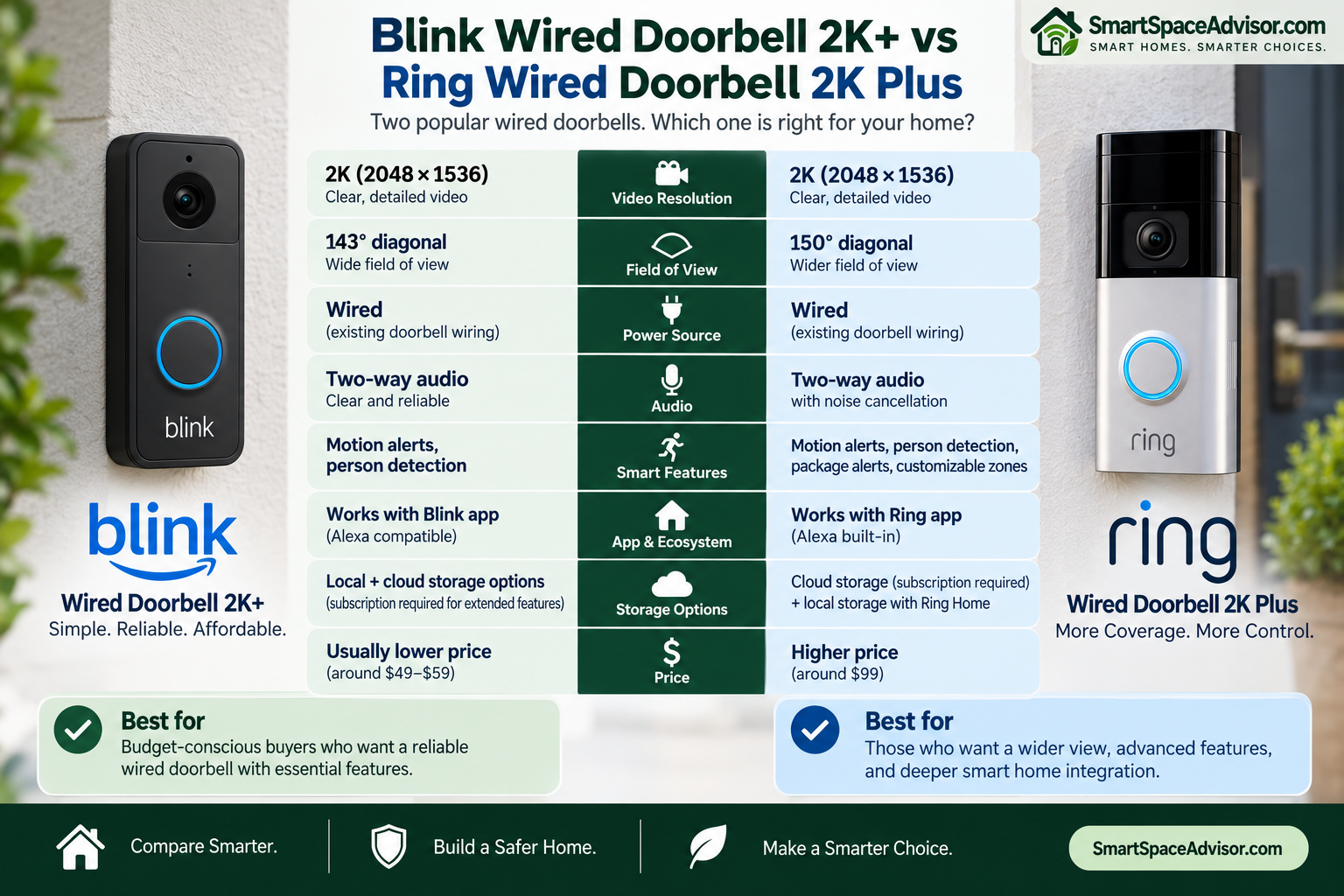
Let’s start with the two wired models.
The Blink Wired Doorbell 2K+ focuses heavily on value. It provides 1920 × 1920 head-to-toe video, a 140-degree horizontal field of view, two-way audio, IP65 weather resistance, and 2.4 GHz Wi-Fi.
It doesn’t require a Sync Module for basic operation, although adding a compatible Sync Module opens up local-storage possibilities.
The Ring Wired Doorbell 2K Plus is a more premium device.
It also provides 2K head-to-toe video, but adds features such as Low-Light Sight, more sophisticated motion detection, and dual-band 2.4/5 GHz Wi-Fi.
Ring therefore offers the more advanced wired doorbell.
Blink offers the better value proposition.
Which Should You Buy?
Choose Blink Wired Doorbell 2K+ if: price, straightforward operation, Alexa integration, and local-storage flexibility matter most.
Choose Ring Wired Doorbell 2K Plus if: you’re willing to spend more for better connectivity, more advanced detection, and deeper integration with a larger Ring security system.
For most budget buyers, we’d choose Blink Wired Doorbell 2K+.
For someone building a more advanced home-security setup, we’d choose Ring Wired Doorbell 2K Plus.
Blink Wired Doorbell 2K+ vs Ring Wired Doorbell 2K
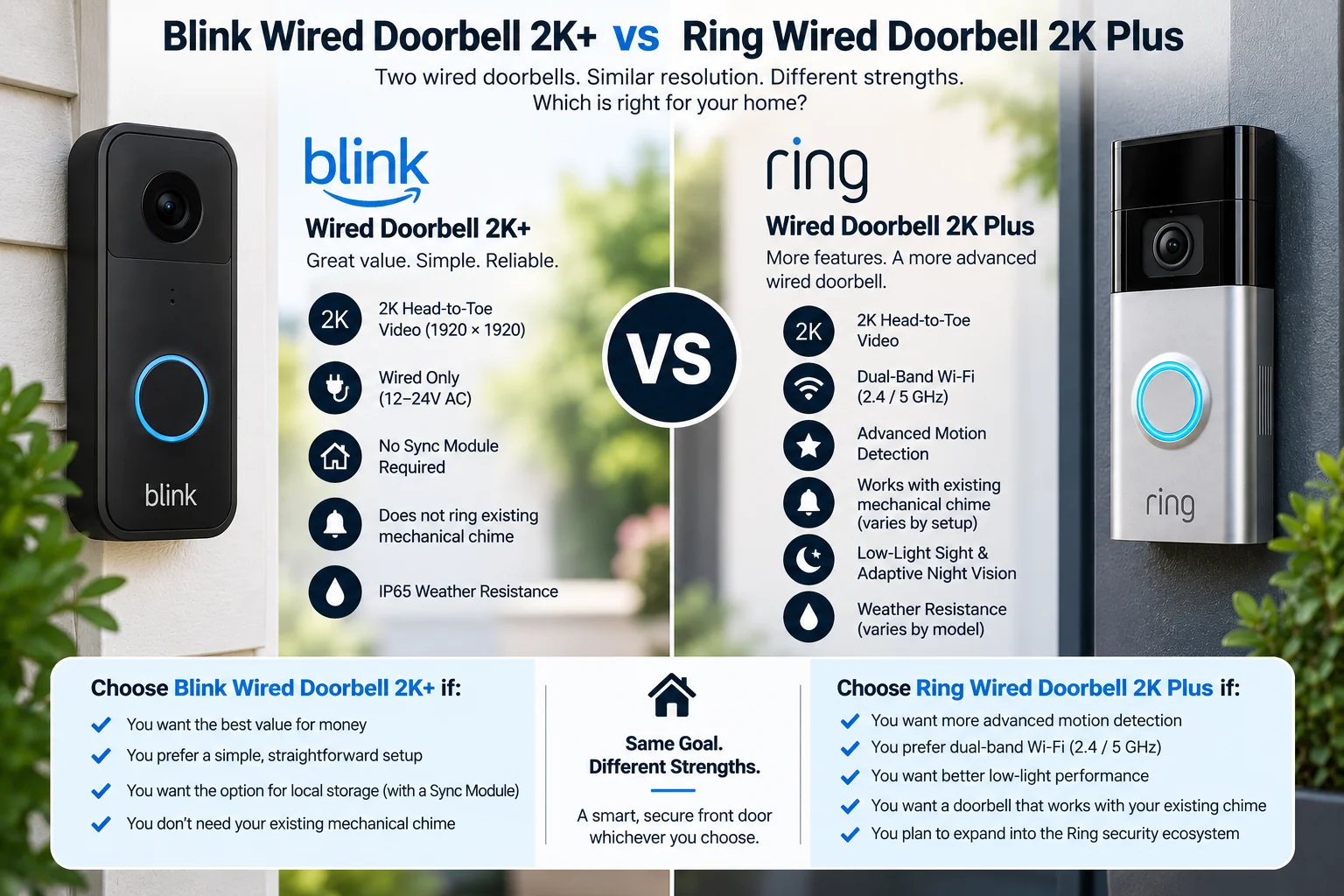
There’s another comparison that’s arguably even more relevant for budget shoppers.
Ring’s Wired Doorbell 2K is the company’s lower-cost wired model and therefore competes more directly with Blink’s value-oriented Wired Doorbell 2K+.
Both give buyers modern 2K head-to-toe video without forcing them into premium doorbell pricing.
This makes the decision much less about raw resolution.
Instead, ask yourself which ecosystem you prefer.
Blink gives you a path toward compatible local storage and a simpler security ecosystem.
Ring gives you access to its larger camera and security platform.
If both models are similarly priced when you’re shopping, your long-term ecosystem preference may matter more than a small difference in upfront cost.
Winner: Blink for local-storage flexibility; Ring for ecosystem
Blink Battery Doorbell 2K+ vs Ring Battery Doorbell 2K Plus
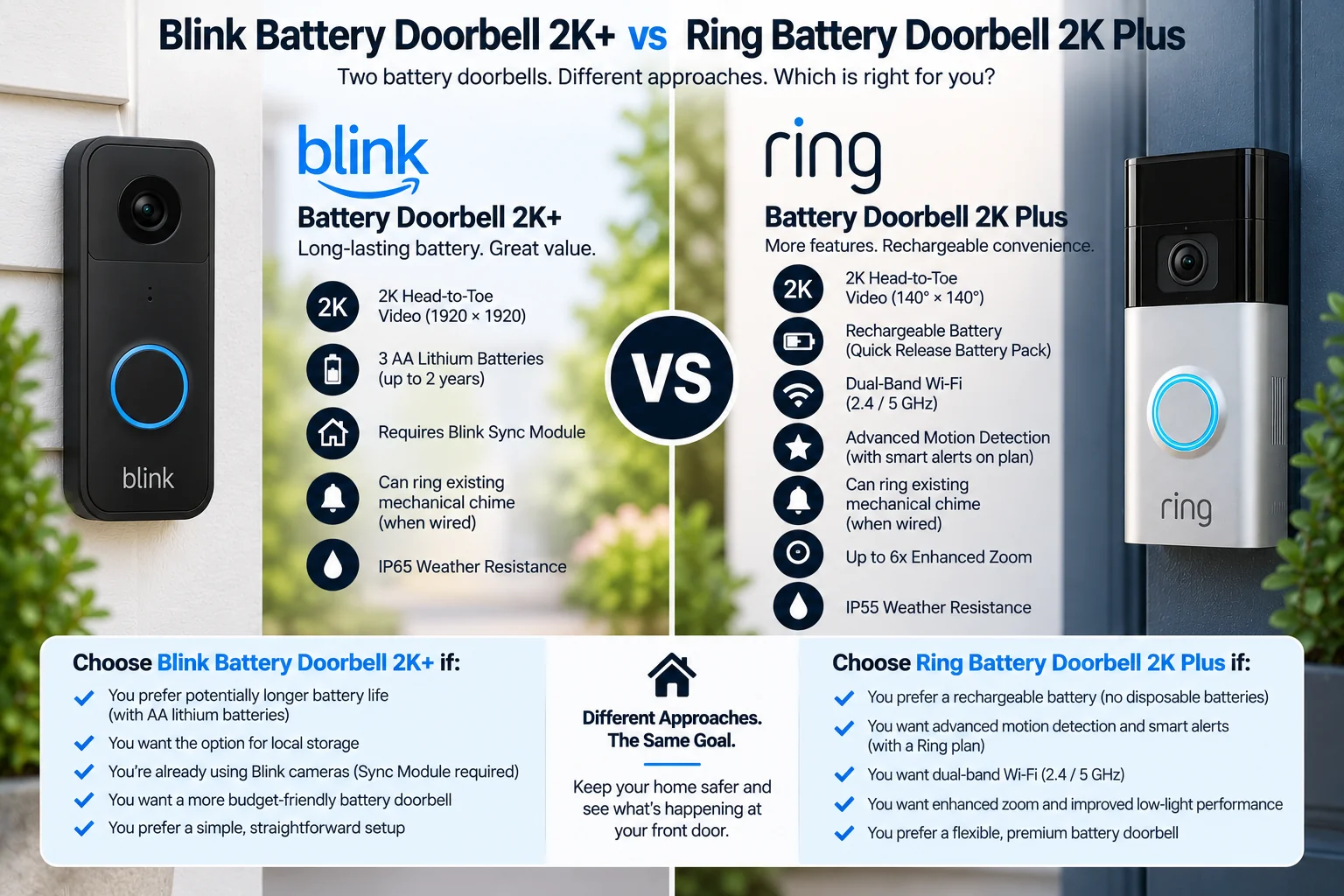
The battery comparison is much more interesting because these devices take very different approaches to power.
The Blink Battery Doorbell 2K+ uses three AA 1.5V lithium batteries. Blink rates battery life at up to two years under default conditions, although real battery life will vary considerably with motion activity, settings, temperature, Live View use, and other factors.
It records 1920 × 1920 head-to-toe video and is rated IP65 for weather resistance.
There’s one important requirement:
Blink Battery Doorbell 2K+ requires a Sync Module to function.
The Ring Battery Doorbell 2K Plus, by contrast, uses a removable rechargeable Quick Release Battery Pack.
It provides Ring’s Retinal 2K video with up to 6x Enhanced Zoom, a 140 × 140-degree head-to-toe view, dual-band Wi-Fi, and advanced motion detection.
The battery pack can be removed, recharged, and placed back into the doorbell.
Which Battery System Is Better?
This comes down to preference.
Blink’s AA lithium approach potentially means going much longer between battery changes under light-to-moderate use.
Ring’s rechargeable battery means you don’t need to keep buying disposable lithium batteries, and a spare battery pack can make swaps quick.
For most people who specifically want a battery doorbell, we prefer Ring’s rechargeable system.
Winner: Ring Battery Doorbell 2K Plus
Video Quality: Blink vs Ring
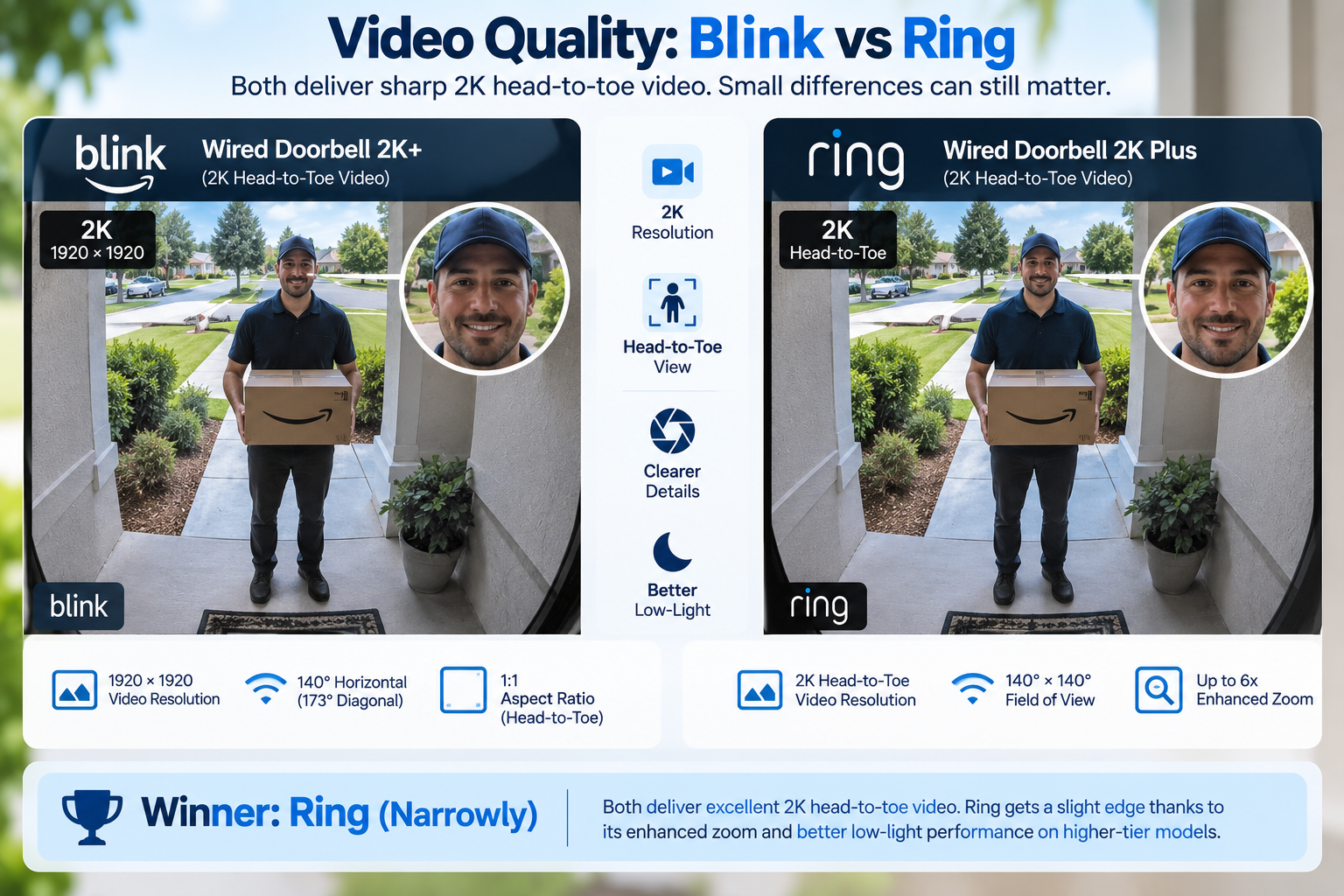
Older comparisons often gave Ring an obvious advantage in video quality.
That’s no longer accurate.
Blink’s current 2K+ doorbells capture 1920 × 1920 video using a 1:1 aspect ratio designed to show visitors from head to toe.
The Blink Wired Doorbell 2K+ offers a 140-degree horizontal field of view and 173-degree diagonal field of view.
The Battery Doorbell 2K+ uses the same 1920p HD color resolution and 1:1 aspect ratio.
Ring’s latest 2K doorbells have also moved to head-to-toe video.
The Ring Battery Doorbell 2K Plus provides a 140-degree horizontal × 140-degree vertical field of view along with up to 6x Enhanced Zoom.
The Ring Wired Doorbell 2K Plus likewise offers 2K head-to-toe coverage.
Winner: Ring, narrowly
Blink has largely eliminated the resolution gap.
Ring gets our slight overall win because its premium models combine 2K video with more sophisticated low-light processing, connectivity, and zoom capabilities.
For straightforward daytime front-door monitoring, however, the difference is much less important than it once was.
Head-to-Toe Video
This feature matters more than marketing numbers suggest.
A traditional landscape camera is good at showing what’s happening across a driveway or yard. A doorbell needs to show something different:
your visitor and the package sitting beneath them.
Blink’s 2K+ models use a square 1:1 image.
Ring’s current 2K models also emphasize head-to-toe coverage.
Both are therefore well suited to monitoring package deliveries.
Winner: Tie
Either brand provides much better doorstep coverage than older wide-but-short doorbell cameras.
Night Vision and Low-Light Performance
Both Blink 2K+ models provide infrared night vision.
That’s sufficient for identifying visitors and monitoring a normally positioned entrance after dark.
Ring pushes further on its more expensive models.
The Ring Wired Doorbell 2K Plus adds Low-Light Sight and Adaptive Night Vision, while the Battery Doorbell 2K Plus also emphasizes improved nighttime visibility.
That makes Ring more attractive for entrances with difficult lighting.
Keep in mind that doorbell placement matters almost as much as the camera itself. Porch lights, reflective walls, street lighting, distance, and mounting angle can all affect nighttime footage.
Winner: Ring
For a normally illuminated porch, either should be adequate.
For difficult low-light environments, Ring has the stronger premium options.
Motion Detection: Which Is Smarter?
The Blink Wired Doorbell 2K+ uses frame-to-frame image comparison for motion detection.
The Blink Battery Doorbell 2K+ uses a passive infrared (PIR) sensor.
Ring’s latest premium models provide Advanced Motion Detection, customizable motion zones, and—in models such as the Wired Doorbell 2K Plus—more sophisticated motion technology.
Ring’s subscription ecosystem also provides intelligent alert features for identifying events such as people, packages, and vehicles on supported devices.
Blink provides smart detection features through eligible plans as well, but Ring’s security platform is more mature.
Winner: Ring
If minimizing unnecessary notifications and building sophisticated detection rules matter to you, Ring has the advantage.
Two-Way Talk
Both brands let you speak to visitors from your phone.
That means you can tell a courier where to leave a package, answer the door while away, or speak to a visitor without opening it.
For basic two-way communication, both work toward the same goal.
Ring’s wider software ecosystem and additional communication features give it a slight advantage, but this isn’t a category that should determine your purchase by itself.
Winner: Ring, narrowly
Blink vs Ring Subscription Costs
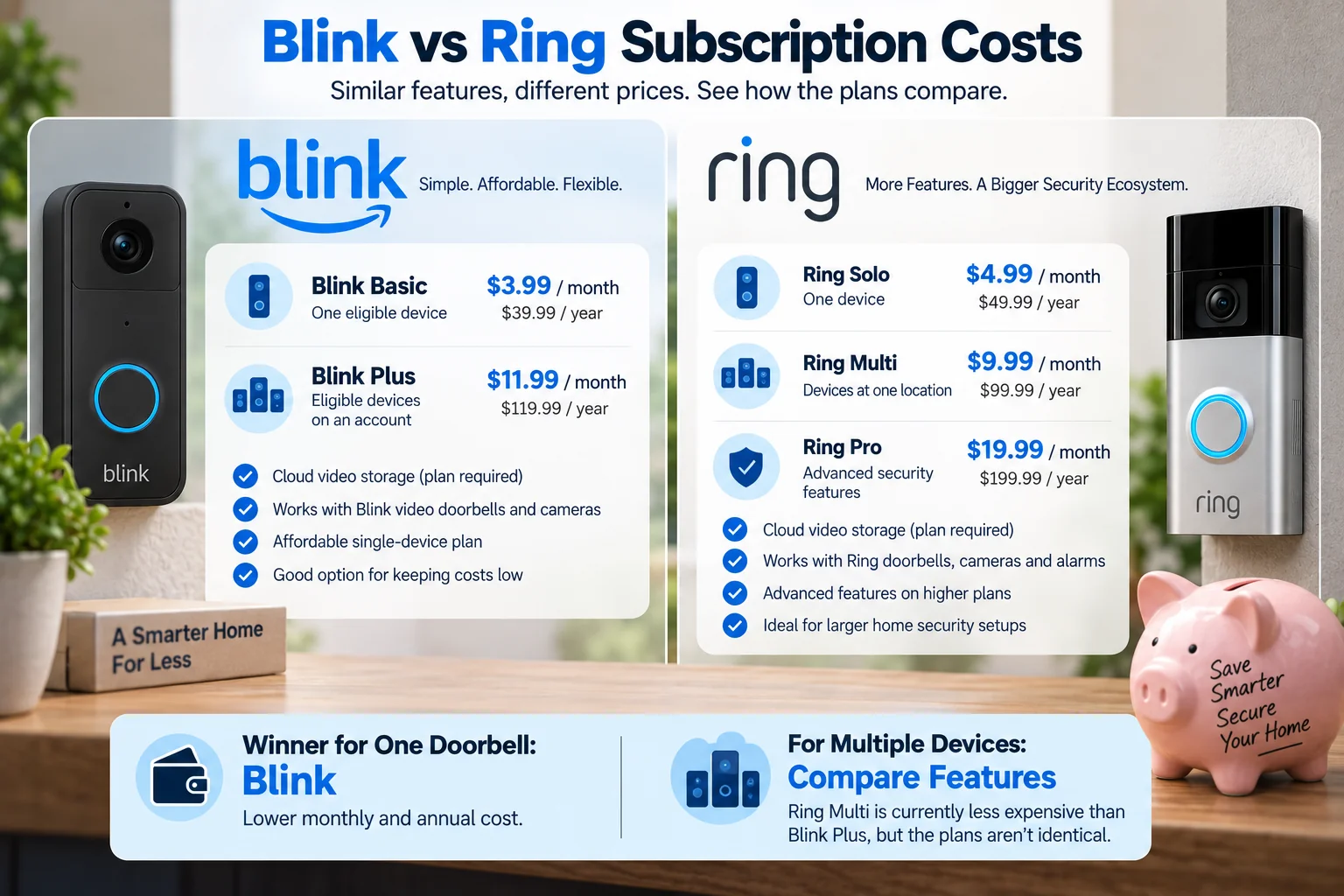
Hardware price is only part of what a video doorbell costs.
If you subscribe for five years, cloud storage can cost more than the doorbell itself.
Blink Plans
Blink’s U.S. Basic plan currently costs:
$3.99/month or $39.99/year
for one eligible device.
Blink Plus costs:
$11.99/month or $119.99/year
for eligible devices on an account.
Ring Plans
Ring Solo currently costs:
$4.99/month or $49.99/year
for one device.
Ring Multi costs:
$9.99/month or $99.99/year
for devices at one location.
Ring Pro costs:
$19.99/month or $199.99/year
and adds more advanced security functionality.
Blink vs Ring Subscription Comparison
| Plan | Monthly | Annual |
|---|---|---|
| Blink Basic | $3.99 | $39.99 |
| Blink Plus | $11.99 | $119.99 |
| Ring Solo | $4.99 | $49.99 |
| Ring Multi | $9.99 | $99.99 |
| Ring Pro | $19.99 | $199.99 |
For one doorbell, Blink’s entry plan is cheaper.
Interestingly, for a household with multiple devices, Ring Multi’s current listed price is lower than Blink Plus. But the plans aren’t identical, so don’t compare them on price alone—compare the features you actually need.
Winner for one doorbell: Blink
For multiple devices, compare the current feature sets before deciding.
Which Works Better Without a Subscription?
This is one of the biggest differences between Blink and Ring.
Both brands allow some functionality without paying every month.
But “works without a subscription” doesn’t necessarily mean:
records and stores every event for you to watch later.
That’s where storage matters.
Local Storage: Blink Has a Major Advantage
Blink provides compatible local-storage options.
The Blink Wired Doorbell 2K+ can connect to a compatible Sync Module for local storage. A compatible Sync Module can store clips using supported USB or microSD storage depending on the module.
The Blink Battery Doorbell 2K+ also supports compatible local storage—but remember that this model requires a Sync Module anyway.
One detail is important:
Not every Blink Sync Module supports local storage.
For example, Sync Module Core does not provide Local Storage or Clip Backup.
So check the exact module before purchasing.
Ring’s standard video-doorbell experience is more cloud-oriented. Without a compatible subscription, you can still use important live functions, but Ring’s recorded-video history is closely tied to its paid plans.
Winner: Blink
If avoiding an ongoing storage subscription is one of your biggest priorities, Blink is the stronger choice.
Five-Year Subscription Cost
Recurring fees look small until you multiply them.
Using today’s annual single-device U.S. prices:
Blink Basic
$39.99 × 5 years = $199.95
Ring Solo
$49.99 × 5 years = $249.95
That’s a difference of roughly $50 over five years.
The bigger advantage for Blink is the possibility of using compatible local storage instead of maintaining cloud recording indefinitely.
Local storage doesn’t reproduce every paid cloud feature, but it’s a meaningful option for buyers who primarily want saved motion clips.
Winner: Blink
Installation: Blink vs Ring
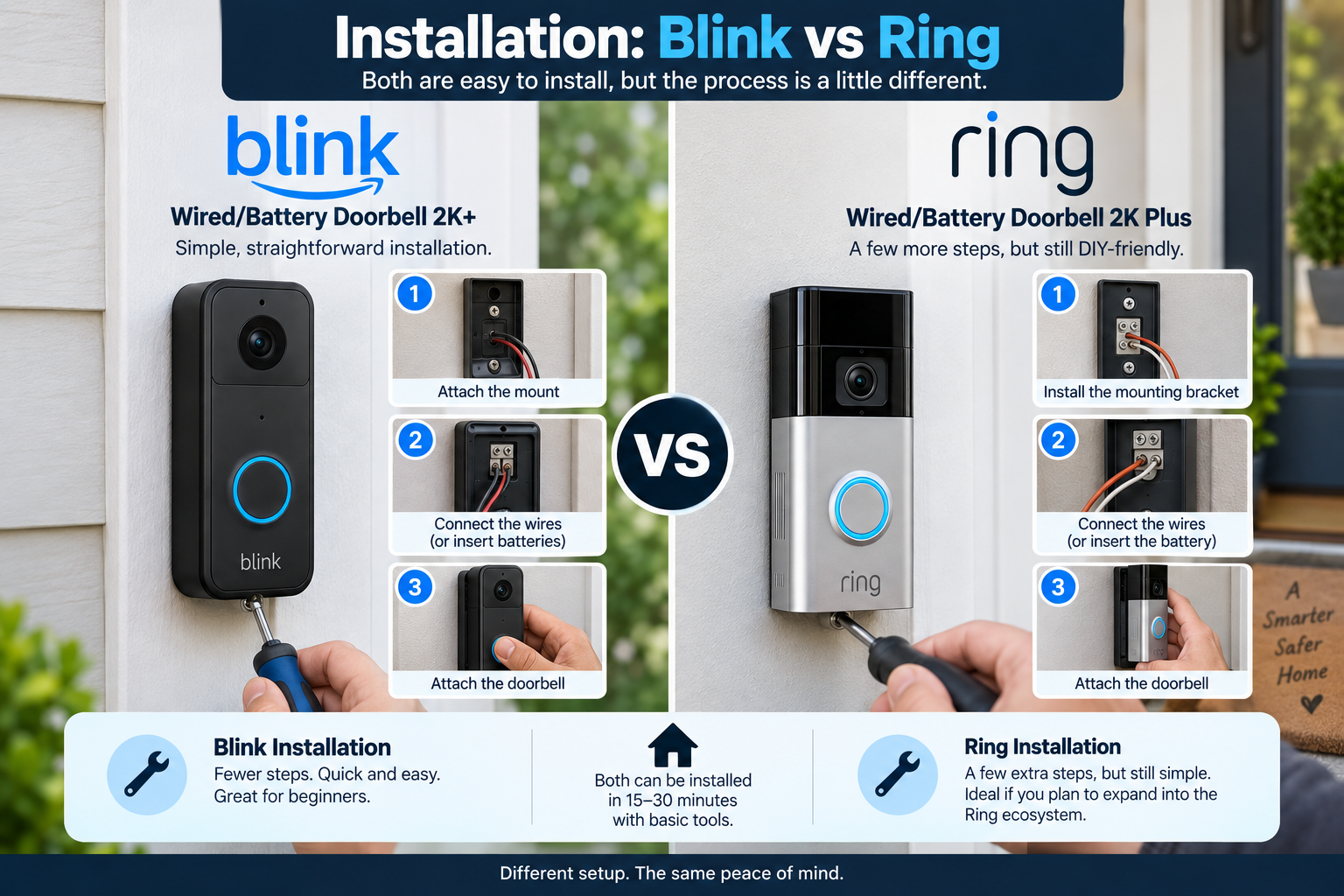
There isn’t one winner here because the answer depends heavily on the model.
Blink Wired Doorbell 2K+
This model is wired-only and contains no battery.
In the U.S., Blink specifies compatible chime wiring at 12–24V AC. A separate 24V plug-in adapter can also provide an installation option where compatible existing wiring isn’t available.
There’s an unusual limitation:
Blink Wired Doorbell 2K+ does not ring your existing mechanical in-home chime.
Installation requires a bypass cable at the mechanical chime, so indoor doorbell sounds need to come from a Blink Chime, compatible Blink Mini, Alexa device, or app notification.
That’s something buyers should know before ordering.
Blink Battery Doorbell 2K+
The battery version can be installed wire-free using three AA lithium batteries.
It can also be connected to compatible existing chime wiring.
Unlike Blink’s dedicated Wired 2K+ model, the Battery Doorbell 2K+ can ring a compatible existing mechanical chime when correctly wired.
Ring Wired Doorbells
Ring’s dedicated wired models make sense for permanent installations where compatible power is already available.
Ring also provides a much larger range of accessories and installation configurations.
Ring Battery Doorbell 2K Plus
Ring’s battery model is especially flexible.
It uses a rechargeable Quick Release Battery Pack but can also be connected to compatible existing doorbell wiring.
Winner: Ring
Ring wins overall because there are more models and power configurations to choose from.
But Blink can be equally straightforward when you’ve already decided exactly which installation type you need.
Mechanical Chime Compatibility
This deserves its own section because it’s easy to misunderstand.
| Model | Existing Mechanical Chime |
|---|---|
| Blink Wired Doorbell 2K+ | No |
| Blink Battery Doorbell 2K+ | Yes, when compatibly wired |
| Blink Video Doorbell (2nd Gen) | Yes, when compatibly wired |
| Ring models | Varies by model/setup |
The surprising part is Blink.
You might assume its dedicated Wired Doorbell 2K+ would be the model most likely to ring your existing mechanical chime.
It doesn’t.
If preserving your existing chime is important, Blink’s Battery Doorbell 2K+ may actually be the better Blink model even when you’re willing to connect doorbell wiring.
Battery Life and Maintenance
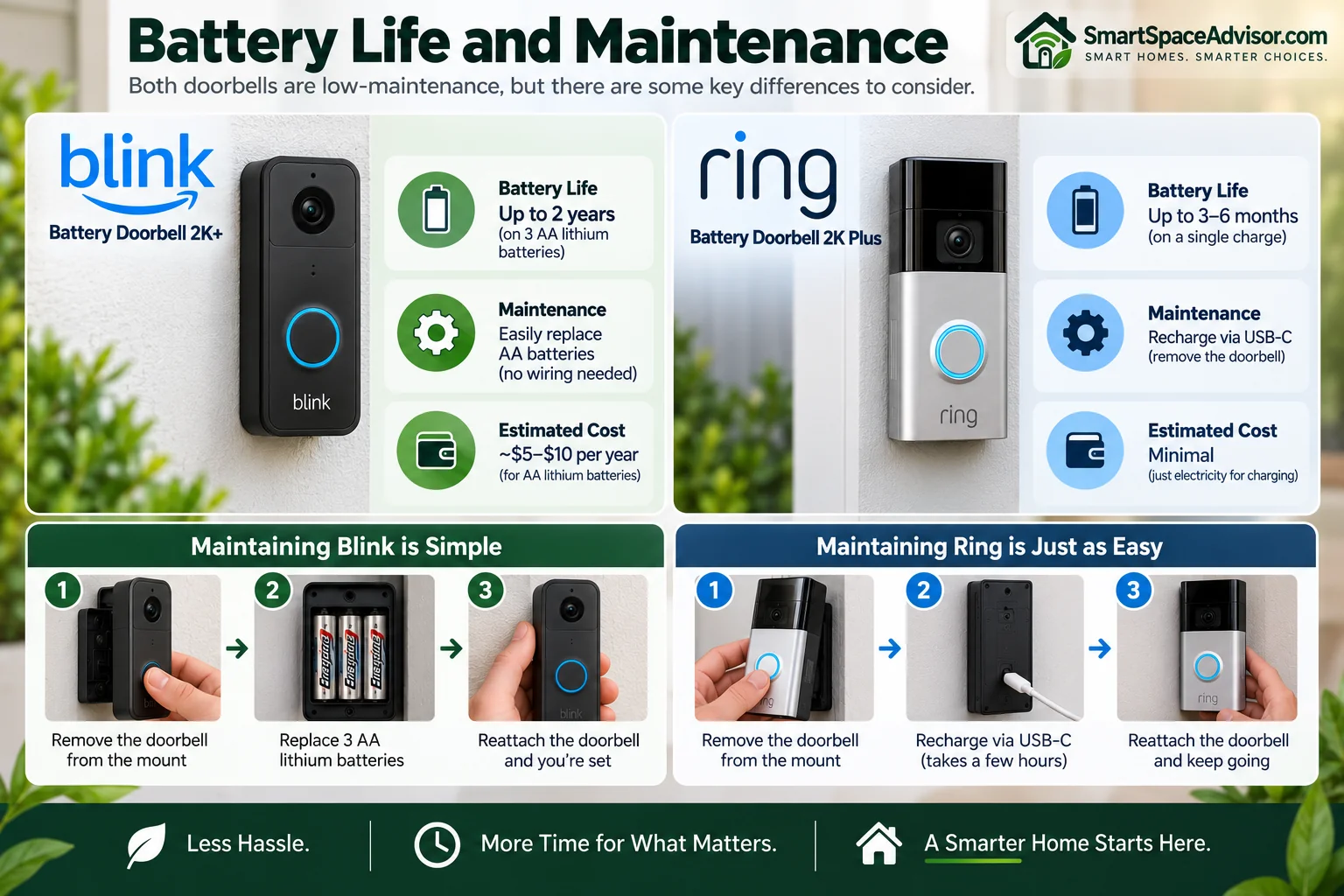
Blink advertises up to two years of battery life for the Battery Doorbell 2K+ under default conditions.
Don’t interpret that as a guarantee.
A busy front entrance with frequent motion events, repeated Live View sessions, cold temperatures, and demanding settings can consume batteries considerably faster.
Ring takes a different approach.
The Battery Doorbell 2K Plus uses a rechargeable Quick Release Battery Pack. Instead of throwing away batteries, you remove the pack, recharge it, and reinstall it.
You can also purchase a spare pack and swap them.
Winner: Depends on your preference
Blink: potentially less frequent maintenance.
Ring: rechargeable and easier to treat like a conventional rechargeable device.
We slightly prefer Ring’s approach for long-term convenience.
Wi-Fi: Ring Has an Advantage
Blink’s current 2K+ doorbells connect over 2.4 GHz Wi-Fi.
That’s not necessarily bad. In fact, 2.4 GHz often reaches farther through walls than 5 GHz, which can be helpful at a front door.
Ring’s Battery Doorbell 2K Plus and higher-tier current models support dual-band 2.4 GHz and 5 GHz connectivity, with newer models also supporting more modern Wi-Fi capabilities.
That gives Ring more network flexibility.
Winner: Ring
If your home network is crowded or you specifically want 5 GHz support, check the Ring model you’re considering.
Weather Resistance
Blink officially rates both its Wired Doorbell 2K+ and Battery Doorbell 2K+ at IP65.
Their listed operating temperature range is approximately:
-5°F to 113°F (-20°C to 45°C).
Ring’s Battery Doorbell 2K Plus is listed as IP55, with an operating range of approximately:
-4°F to 122°F (-20°C to 50°C).
IP ratings aren’t the only measure of outdoor durability, but Blink’s IP65 specification provides stronger rated protection against water jets than an IP55 rating.
Winner on stated IP rating: Blink
Regardless of brand, good placement under some shelter is preferable where possible.
Alexa Integration
This is the least surprising tie in the article.
Amazon owns both Blink and Ring.
Both ecosystems work particularly naturally with Alexa and compatible Echo devices.
Depending on the device and configuration, Alexa can provide doorbell announcements and display supported camera feeds on Echo Show devices.
If your home already has Echo speakers and displays everywhere, both brands make sense.
Winner: Tie
Don’t choose between Blink and Ring based on Alexa alone.
Google Home and Apple Home
Neither brand would be our first recommendation for someone whose number-one requirement is deep native Apple Home integration.
The same caution applies to Google-centered households: compatibility and available functions can vary, so check the exact feature you need rather than assuming every Alexa feature has a Google equivalent.
Blink and Ring are at their most natural inside an Alexa-first home.
Winner: Neither
If Apple Home or Google Home integration is central to your smart-home strategy, compare other doorbell ecosystems before committing.
Blink App vs Ring App
Blink’s app reflects Blink’s overall philosophy.
It’s relatively straightforward.
If you have a doorbell and a few cameras, that simplicity can be an advantage.
Ring’s app needs to manage a much larger security ecosystem. That creates more functionality and more room for advanced configurations.
For a single doorbell:
Blink’s simplicity is appealing.
For a multi-camera security system:
Ring’s depth is more valuable.
Winner: Ring for capability; Blink for simplicity
Smart-Home Security Ecosystem
Ring wins this category decisively.
Blink focuses primarily on accessible DIY cameras and doorbells.
Ring’s ecosystem stretches much further into comprehensive home security.
That matters if today’s video doorbell is only your first purchase.
You might eventually want:
- outdoor cameras;
- indoor cameras;
- additional doorbells;
- security sensors;
- alarms;
- smart lighting;
- more advanced monitoring.
If you’re likely to build a substantial security system over time, Ring provides the stronger foundation.
Winner: Ring
If you only want a good doorbell and perhaps a few cameras, Blink’s smaller ecosystem may be all you need.
Blink vs Ring for Renters
Renters generally benefit from battery power and minimal permanent modification.
Ring’s Battery Doorbell 2K Plus is particularly attractive here because it combines a removable rechargeable battery with optional no-drill mounting accessories.
Blink’s Battery Doorbell 2K+ can also be installed wire-free, but it requires a Sync Module to function.
That means the Blink setup involves an additional device.
Winner: Ring Battery Doorbell 2K Plus
For renters prioritizing simple installation and easy removal, Ring has the edge.
Blink vs Ring for Homeowners
Homeowners with existing compatible wiring have more options.
For a relatively inexpensive permanent setup, Blink Wired Doorbell 2K+ makes a lot of sense.
For someone willing to spend more on advanced features, Ring Wired Doorbell 2K Plus is the more capable option.
The mechanical-chime limitation on Blink’s Wired 2K+ is worth considering, however.
Winner: Depends on budget
Value: Blink Wired Doorbell 2K+
Premium experience: Ring Wired Doorbell 2K Plus
Which Is Better for Package Deliveries?
Both current 2K lineups have become significantly better suited to packages because of their head-to-toe views.
You can see more of the area directly beneath the doorbell rather than only the visitor’s upper body.
Ring has an advantage in the broader smart-alert ecosystem on compatible plans and devices.
Blink counters with lower-cost storage options.
Winner: Ring for smarter alerts; Blink for value
Blink Pros and Cons
Pros
- Excellent value
- 2K head-to-toe options
- Compatible local storage
- Lower-cost single-device cloud plan
- Strong Alexa integration
- IP65 rating on current 2K+ doorbells
- Simple ecosystem
- Good choice for budget buyers
Cons
- Smaller security ecosystem
- Wired Doorbell 2K+ doesn’t ring an existing mechanical chime
- Battery Doorbell 2K+ requires a Sync Module
- 2.4 GHz Wi-Fi only on current 2K+ doorbells
- Some smart features require a paid plan
- Battery model uses disposable lithium AA batteries
Ring Pros and Cons
Pros
- Much broader doorbell lineup
- 2K and higher-end 4K options
- Strong head-to-toe video
- Advanced motion capabilities
- Excellent Alexa integration
- Rechargeable battery options
- Dual-band Wi-Fi on higher-tier models
- Larger security ecosystem
- Better upgrade path
Cons
- Cloud recording is heavily tied to subscription plans
- Single-device subscription costs more than Blink Basic
- Premium models can become expensive
- No equivalent to Blink’s straightforward local-storage advantage
- More ecosystem than some users actually need
Blink vs Ring: Best Model by Buyer
| Buyer | Our Pick |
|---|---|
| Budget wired setup | Blink Wired Doorbell 2K+ |
| Affordable Ring wired setup | Ring Wired Doorbell 2K |
| Premium wired setup | Ring Wired Doorbell 2K Plus |
| Battery-powered setup | Ring Battery Doorbell 2K Plus |
| Blink battery setup | Blink Battery Doorbell 2K+ |
| Local storage | Blink 2K+ + compatible Sync Module |
| Existing Blink household | Blink 2K+ model |
| Existing Ring household | Ring 2K model |
| Alexa household | Either |
| Renter | Ring Battery Doorbell 2K Plus |
| Large security system | Ring |
| Lowest long-term storage cost | Blink |
Which Blink Doorbell Should You Buy?
For most homeowners with suitable wiring, our Blink pick is the Blink Wired Doorbell 2K+.
It provides the important modern features—2K head-to-toe video, Alexa support, two-way audio, and optional local storage—without requiring a Sync Module for basic operation.
Its biggest drawback is the lack of existing mechanical-chime support.
If you don’t have suitable wiring, or keeping your existing compatible mechanical chime matters, consider the Blink Battery Doorbell 2K+ instead.
The Blink Video Doorbell (2nd Gen) makes more sense when price matters more than getting Blink’s 2K resolution.
Which Ring Doorbell Should You Buy?
For budget wired buyers, start with the Ring Wired Doorbell 2K.
If you want better low-light capabilities, more advanced motion detection, and a more premium wired doorbell, step up to the Ring Wired Doorbell 2K Plus.
For battery installations, the Ring Battery Doorbell 2K Plus is our preferred mainstream Ring battery model thanks to its 2K head-to-toe video and removable rechargeable battery.
Ring’s more expensive 4K models exist for buyers who want to move beyond this class, but most households don’t need to jump straight to the most expensive option.
Is Ring Worth Paying More For?
It can be.
Ring’s extra cost makes sense if you’re actually going to use what you’re paying for.
That means things like:
- more advanced motion features;
- a broader security ecosystem;
- premium low-light performance;
- more flexible model selection;
- rechargeable battery options;
- future expansion.
But if all you want is a camera at your front door that shows who’s there and saves useful clips, Blink can accomplish the core job for less.
Don’t pay for an ecosystem you don’t intend to use.
Is Blink Good Enough Compared With Ring?
Yes.
Calling Blink simply the cheap alternative to Ring is increasingly outdated.
The Blink Wired Doorbell 2K+ and Battery Doorbell 2K+ now provide 1920 × 1920 head-to-toe video, bringing their basic camera specifications much closer to mainstream Ring models.
The bigger difference isn’t camera resolution anymore.
It’s everything surrounding the camera:
Ring gives you the more sophisticated ecosystem.
Blink gives you the simpler, more cost-conscious ecosystem.
For many households, simpler is enough.
Blink vs Ring: Final Verdict
There isn’t one winner for every household.
But there are clear winners for different types of buyers.
Choose Blink if you want:
- strong value for money;
- 2K head-to-toe video without moving into premium pricing;
- compatible local video storage;
- a cheaper single-device cloud plan;
- excellent Alexa integration;
- a straightforward camera ecosystem;
- lower long-term costs.
Our Blink recommendation for most wired homes is the Blink Wired Doorbell 2K+.
For homes that need battery power, consider the Blink Battery Doorbell 2K+.
Choose Ring if you want:
- more doorbell models to choose from;
- advanced motion detection;
- better premium low-light features;
- rechargeable battery options;
- dual-band Wi-Fi on compatible models;
- a larger home-security ecosystem;
- more room to expand later.
For budget wired installations, consider the Ring Wired Doorbell 2K.
For a more premium wired setup, choose the Ring Wired Doorbell 2K Plus.
For battery installations, we’d choose the Ring Battery Doorbell 2K Plus.
Our Overall Recommendation
For a budget-conscious homeowner who primarily wants a good video doorbell, we lean toward Blink.
For someone who wants to build a larger, more sophisticated home-security system, we prefer Ring.
And if we had to summarize the entire Blink vs Ring comparison in one sentence:
Blink is the better value ecosystem; Ring is the better security ecosystem.
Frequently Asked Questions
Is Blink better than Ring?
Blink is better for many budget-conscious buyers, particularly those who value compatible local storage and lower single-device subscription costs. Ring is better for buyers who want a larger security ecosystem, more doorbell models, and more advanced premium features.
Which Blink doorbell is best?
The Blink Wired Doorbell 2K+ is our preferred Blink model for homes with suitable wiring because it provides 2K head-to-toe video and doesn’t require a Sync Module for basic operation. The Battery Doorbell 2K+ is the better choice when you need a wire-free installation.
Which Ring doorbell is best?
It depends on your budget. The Ring Wired Doorbell 2K is a strong lower-cost wired option, while the Wired Doorbell 2K Plus offers more premium features. For battery installations, the Ring Battery Doorbell 2K Plus is one of the strongest mainstream choices.
Is Blink cheaper than Ring?
Blink generally emphasizes value, and its U.S. Basic subscription for one eligible device currently costs $3.99/month or $39.99/year. Ring Solo currently costs $4.99/month or $49.99/year for one device. Hardware pricing varies by model and promotions.
Which is better without a subscription, Blink or Ring?
Blink has the advantage for buyers who want locally stored recorded clips without an ongoing cloud-storage subscription. Compatible Blink doorbells can use local storage through supported Sync Modules and storage media.
Does Blink record without a subscription?
Compatible Blink devices can save clips locally using an appropriate Sync Module and supported USB or microSD storage. Exact requirements depend on the Sync Module. Some modules, such as Sync Module Core, do not support Local Storage.
Does Ring record without a subscription?
Ring provides core real-time features without a subscription, but recorded video history and various advanced features are tied to compatible Ring plans.
Is Blink owned by Amazon?
Yes. Blink is an Amazon company.
Is Ring owned by Amazon?
Yes. Amazon also owns Ring.
Do Blink and Ring work with Alexa?
Yes. Both ecosystems integrate closely with compatible Alexa devices and are particularly well suited to Alexa-based smart homes.
Can Blink and Ring work together?
Blink and Ring use separate apps and don’t become one unified camera system. However, compatible devices from both brands can interact with Alexa, which can provide a common interface for some functions.
Which has better video quality: Blink or Ring?
Current Blink 2K+ doorbells provide 1920 × 1920 head-to-toe video, while Ring’s current 2K models also provide 2K head-to-toe video. Ring offers more premium models and additional imaging features, so it has the higher ceiling, but the basic resolution gap between mainstream models is now small.
Which has better night vision?
Ring has the advantage when comparing premium models because doorbells such as the Ring Wired Doorbell 2K Plus add more sophisticated low-light capabilities. Blink’s current 2K+ models provide infrared night vision that should be sufficient for many normally lit entrances.
Which is better for renters?
We prefer the Ring Battery Doorbell 2K Plus for renters because it uses a removable rechargeable battery and supports flexible installation options. Blink’s Battery Doorbell 2K+ is also wire-free but requires a Sync Module.
Which is better for an existing mechanical doorbell chime?
This depends on the exact model. Blink’s Wired Doorbell 2K+ does not ring an existing mechanical chime. Blink Battery Doorbell 2K+ can ring a compatible in-home chime when wired correctly. Ring compatibility varies by model and installation, so check the requirements of the specific Ring doorbell before purchasing.
Does Blink Battery Doorbell 2K+ need a Sync Module?
Yes. Blink states that a Sync Module is required for the Battery Doorbell 2K+ to function.
Does Blink Wired Doorbell 2K+ need a Sync Module?
No. Blink Wired Doorbell 2K+ connects directly to Wi-Fi and doesn’t require a Sync Module for basic operation. A compatible Sync Module can be added if you want supported local-storage functionality.
Blink or Ring: which should I buy in 2026?
Buy Blink if value, local storage, and keeping recurring costs low are your priorities. Buy Ring if advanced security features, rechargeable battery options, and building a larger home-security ecosystem matter more.

Ryan Hayes
Founder & EditorRyan Hayes is the founder and editor of Smart Space Advisor, where he researches and evaluates smart home technology to help readers make informed buying decisions. His work focuses on smart security, video doorbells, smart plugs, lighting, and connected-home platforms including Matter, Alexa, Google Home, and Apple Home. By combining product research, manufacturer documentation, feature comparisons, and real-world considerations, Ryan aims to cut through technical jargon and provide practical, straightforward advice about which smart home products offer genuine value.