
Affiliate Disclosure: SmartSpaceAdvisor.com is a participant in the Amazon Services LLC Associates Program. We may earn a commission when you buy through our links at no extra cost to you. Our recommendations are always based on honest research — never paid placements.
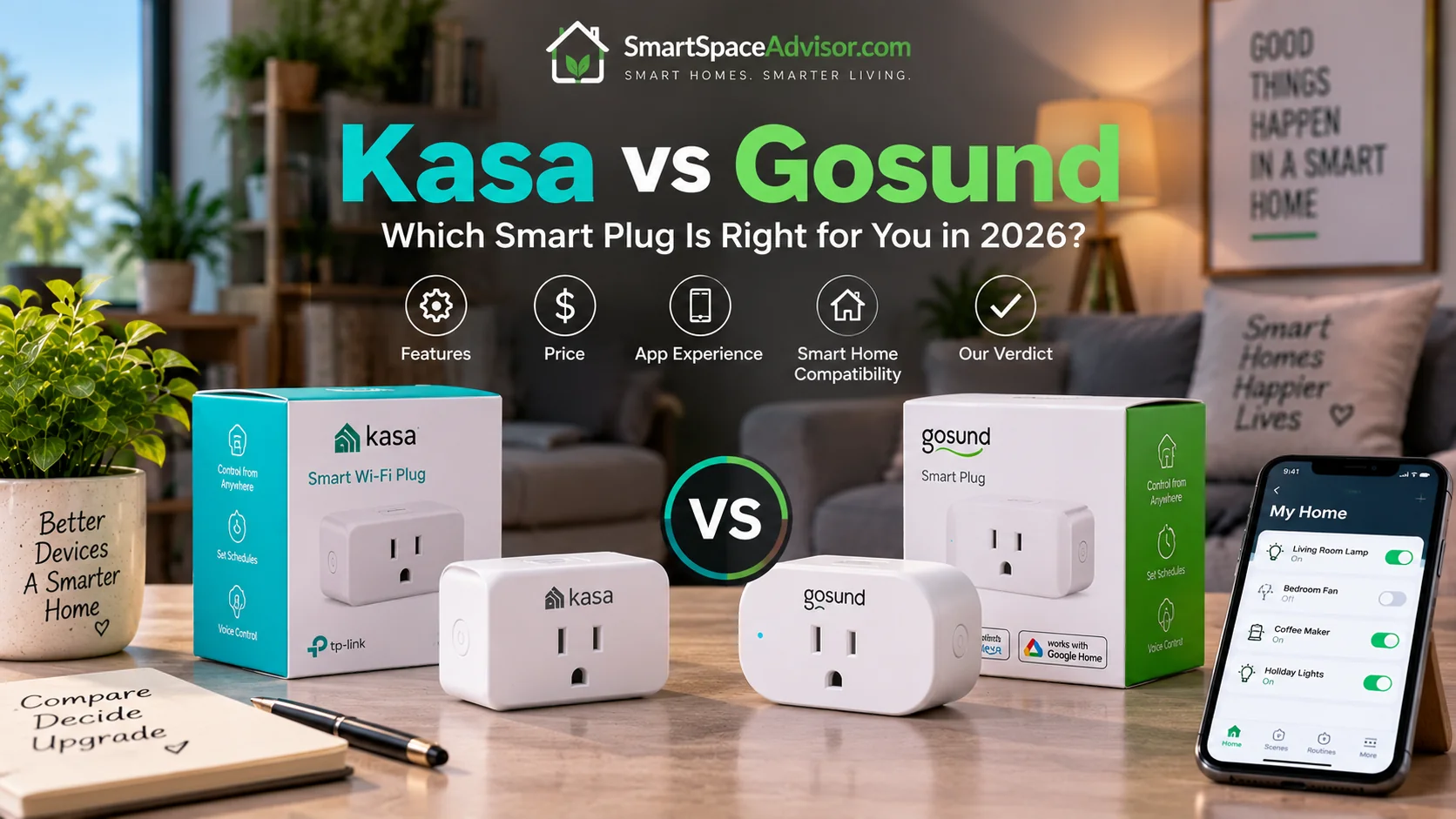
If you’ve spent any time browsing smart plugs on Amazon, you’ve almost certainly seen both of these names — often sitting right next to each other in the search results, sometimes within a dollar or two of the same price. Kasa (made by TP-Link) and Gosund both dominate the budget smart plug category, and on paper, their listings can look nearly identical: Wi-Fi connectivity, Alexa and Google Home support, compact design, similar photos of a small white cube plugged into a wall outlet.
So which one should actually end up in your cart?
We compared both brands across the factors that matter most in real, everyday use — not just spec-sheet claims — to give you a straight answer. The short version: they’re closer than you might expect in day-to-day function, but there are real, meaningful differences once you look past the price tag.
How We Compared These Two Brands
We evaluated both brands’ current flagship smart plugs — the Kasa EP25, our top overall pick in our complete smart plugs guide, against Gosund’s most popular current model — across five factors: setup experience, app quality and long-term reliability, energy monitoring accuracy, physical build quality, and genuine price-to-value. We drew on verified owner feedback, manufacturer documentation, and the same evaluation framework we apply across every comparison on this site.
The Quick Verdict
If you only read one paragraph of this comparison, here it is: Kasa is the better overall choice for most buyers, and it’s not particularly close. Gosund plugs are genuinely cheaper — often $2–4 less per unit — and that price gap is real. But Kasa’s advantages in app reliability, long-term firmware support, and brand longevity are the kind of differences you don’t notice on day one and absolutely notice eighteen months later.
That said, Gosund isn’t a bad product — it’s a legitimate, certified option that works well for specific situations we’ll cover below. This isn’t a “one is good, one is bad” comparison; it’s a “which trade-offs matter to you” comparison.
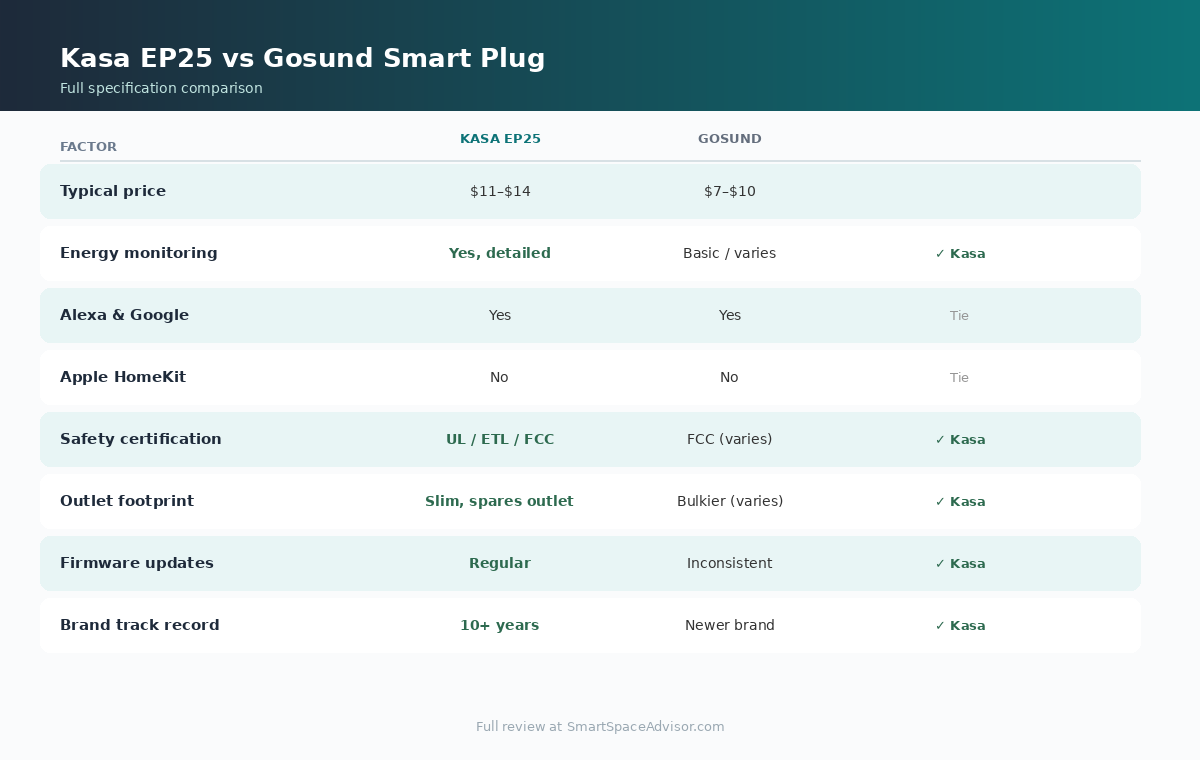
Kasa vs Gosund: Side-by-Side Comparison
| Factor | Kasa EP25 | Gosund Smart Plug |
|---|---|---|
| Typical price | $11–$14 per plug | $7–$10 per plug |
| Wi-Fi band | 2.4GHz | 2.4GHz |
| Energy monitoring | Yes, detailed | Basic on select models only |
| App | Kasa app (TP-Link) | Gosund/Smart Life app |
| Alexa/Google support | Yes, both | Yes, both |
| Apple HomeKit | No | No |
| Physical footprint | Slim, doesn’t block adjacent outlet | Slightly bulkier on some models |
| Company track record | 10+ years in smart home | Newer, less established |
| Firmware update frequency | Regular, ongoing | Inconsistent across models |
| Safety certification | UL/ETL/FCC | FCC (varies by model/seller) |
Setup Experience
Both plugs follow essentially the same setup pattern: download the app, plug in the device, put it into pairing mode, connect to your 2.4GHz Wi-Fi network. In our research, both processes typically complete in under five minutes for a single plug.
Where they diverge is app polish during that first setup. The Kasa app has been refined across roughly a decade of iteration — the pairing flow is well-documented, error messages are specific and actionable when something goes wrong, and the app reliably detects new devices on the first attempt in the overwhelming majority of owner reports.
Gosund plugs typically pair through the Smart Life app — a shared, white-label platform used by dozens of budget smart home brands, not just Gosund. This app is functional but noticeably more generic; setup works, but troubleshooting guidance is thinner, and because so many different brands share this same app infrastructure, updates and bug fixes can feel less consistently prioritized for any single brand’s specific hardware quirks.
Verdict on setup: Both work. Kasa’s process is smoother and better documented if something goes wrong.
App Quality and Long-Term Reliability
This is where the gap widens the most, and it’s the single biggest factor behind our overall recommendation.
The Kasa app has a genuine multi-year track record of stability. Scheduling, grouping multiple plugs, energy monitoring dashboards, and voice assistant integration all work consistently, and TP-Link pushes regular app and firmware updates — meaning security patches and bug fixes continue arriving well after your purchase date.
Gosund’s Smart Life app experience is more mixed. Basic functions — on/off, simple scheduling — work reliably enough. But owner reports around more advanced features (energy tracking on models that include it, multi-device scenes, occasional connectivity drops requiring a full re-pair) appear more frequently in long-term reviews than with Kasa. Because Gosund is a smaller company relying on shared third-party app infrastructure rather than in-house software, the pace and consistency of updates is less predictable.
Verdict on app/reliability: Kasa’s advantage here is real and compounds the longer you own the product.
Energy Monitoring
The Kasa EP25 includes detailed energy monitoring as standard — real-time wattage, daily and monthly consumption history, and cost estimates based on your local electricity rate. We covered why this feature specifically tends to pay for itself in our full smart plugs guide: it routinely exposes appliances quietly drawing power you didn’t know about.
Gosund’s energy monitoring is inconsistent across its product lineup — some models include basic wattage tracking, many budget variants skip it entirely to hit a lower price point. If energy monitoring matters to you, you’ll need to check the specific Gosund model carefully rather than assuming it’s included, whereas every current Kasa EP25 unit includes it by default.
Verdict on energy monitoring: Kasa wins clearly and consistently; Gosund is a coin flip depending on the specific model.
Build Quality and Physical Design
Both plugs are compact, but Kasa’s housing design has been specifically refined to avoid blocking the second outlet in a standard duplex receptacle — a small detail that matters more than it sounds once you’re trying to use both sockets behind a couch or desk.
Gosund plugs vary more by model here; some recent versions have improved their footprint, but older and budget variants remain noticeably bulkier, more likely to block an adjacent outlet.
Certification is also worth flagging directly: Kasa plugs consistently carry UL, ETL, and FCC certification. Gosund’s certification can vary by specific model and seller — worth double-checking the listing before buying, since this is a genuine electrical safety consideration, not just a formality. If you’re building beyond smart plugs, our guide to the best smart light bulbs under $20 is a good next step.
Verdict on build quality: Kasa is more consistent; Gosund varies by model, so check specifics before buying.
Price: Where Gosund Actually Wins
This is Gosund’s real, legitimate advantage — it’s not a marketing illusion. At $7–$10 per plug versus Kasa’s $11–$14, Gosund is meaningfully cheaper, especially once you’re buying four, six, or eight plugs to outfit a whole home.
For a household buying eight plugs, that price difference adds up to roughly $25–$35 in total savings — genuinely worth considering if you’re on a tight budget or automating a lot of low-stakes outlets (holiday lights, a spare lamp, a fan you rarely think about).
If you’re building an entire smart home on a limited budget, see our guide to the best budget smart home devices under $50.
Verdict on price: Gosund wins clearly on pure sticker price.
Which Should You Actually Buy?
Based on everything above, here’s our honest, situation-based recommendation:
Buy Kasa if:
- You want the single most reliable, best-supported smart plug in this price range
- Energy monitoring matters to you
- You’re automating anything even slightly important (an aquarium, a freezer, a security-adjacent device)
- You want a company with a strong multi-year track record of software support
Consider Gosund if:
- Budget is your primary constraint and you’re buying in bulk
- The device is for low-stakes automation (string lights, a spare lamp) where occasional connectivity hiccups are a minor inconvenience, not a real problem
- You’ve specifically verified the model you’re buying includes the features (energy monitoring, correct certification) you actually want
Our honest take: for most readers of this site, the $3–4 per-plug price difference is genuinely small in absolute terms, and Kasa’s reliability and feature completeness make it worth that gap for the vast majority of use cases. We’d only actively recommend Gosund for large, low-stakes bulk deployments where minimizing per-unit cost is the primary goal. If you’re specifically looking for cross-platform compatibility, see our guide explaining what Matter is and how it works.
Note: Gosund’s Matter support has changed recently, so compatibility should be checked against the exact model and firmware version before purchase.
Frequently Asked Questions
Is Gosund a legitimate, safe brand to buy from?
Yes, generally — Gosund is an established brand sold widely on Amazon with real certification on most models, not an anonymous marketplace listing. It’s a legitimate budget option, just with more model-to-model variation in features and build quality than Kasa, and it’s worth double-checking the specific listing’s certification before purchasing.
Can I mix Kasa and Gosund plugs in the same home?
Yes, without any real issue. Both work independently through their own apps and both integrate with Alexa and Google Home, so you can voice-control plugs from either brand through the same smart speaker even if you’re managing them in two separate apps day-to-day.
Does Gosund work with Apple HomeKit?
No — neither Kasa’s EP25 nor most current Gosund plugs support Apple HomeKit natively. If HomeKit compatibility matters to you, see our smart plugs guide for HomeKit-specific and Matter-certified alternatives that work with Apple Home.
Which brand has better customer support?
TP-Link (Kasa’s parent company) has a longer-established, more consistently staffed support operation, reflecting its position as a larger, more established networking company overall. Gosund’s support is more limited, typical of a smaller budget-focused brand — response times and resolution quality are reported as more inconsistent in owner reviews.
Is the price difference between Kasa and Gosund worth it?
For most buyers, yes — the roughly $3–4 per-plug gap buys meaningfully better app reliability, more consistent energy monitoring, and stronger long-term firmware support. The exception is large bulk purchases for low-stakes uses, where Gosund’s lower sticker price has a stronger case.
Do both brands offer a warranty?
Both typically offer standard limited warranties (commonly one year), though exact terms can vary by specific product listing and seller. Always check the current warranty terms on the actual product page before purchasing, since these details can change.
Our Verdict
Kasa and Gosund plugs look nearly identical in a search results page, but they’re not equivalent products once you look past the price. Kasa is our recommended choice for the vast majority of buyers — the combination of consistent energy monitoring, stronger app reliability, and a longer corporate track record justifies the modest price premium for nearly every use case we can think of.
Gosund remains a reasonable choice specifically for large, low-stakes bulk purchases where minimizing cost per outlet is the clear priority over long-term polish.

Ryan Hayes
Founder & EditorRyan Hayes is the founder and editor of Smart Space Advisor, where he researches and evaluates smart home technology to help readers make informed buying decisions. His work focuses on smart security, video doorbells, smart plugs, lighting, and connected-home platforms including Matter, Alexa, Google Home, and Apple Home. By combining product research, manufacturer documentation, feature comparisons, and real-world considerations, Ryan aims to cut through technical jargon and provide practical, straightforward advice about which smart home products offer genuine value.