
If you’ve shopped for a smart plug, bulb, or doorbell any time in the last two years, you’ve probably noticed a small badge appearing on more and more product listings: a black-and-white icon that looks a little like a home viewed from above, with the word Matter printed beside it.
It’s easy to scroll past. Product pages are already crowded with badges — Works with Alexa, Works with Google Home, Energy Star, UL Listed — and Matter can look like just one more logo competing for attention. But this particular badge represents something genuinely different from the others: an industry-wide truce.
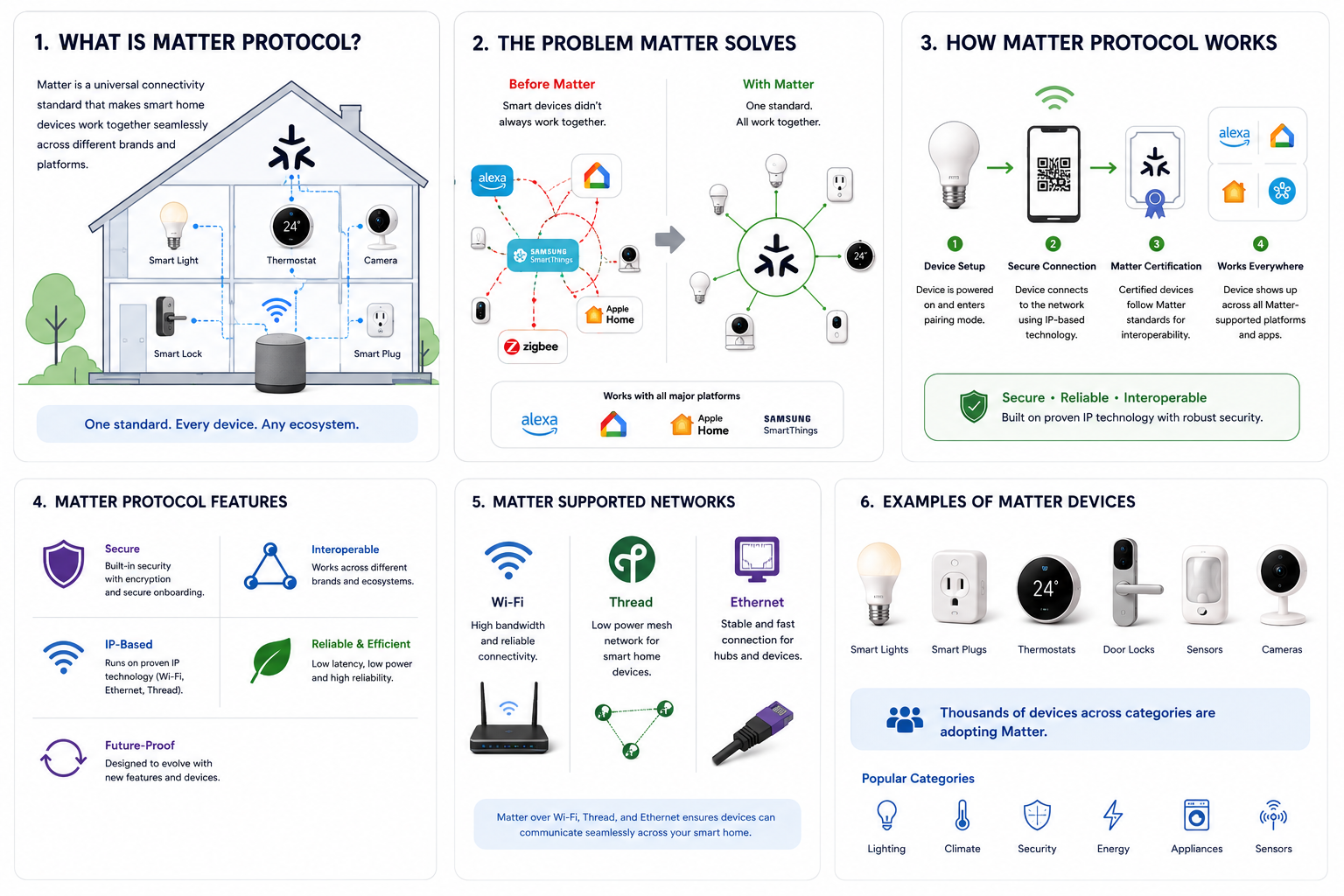
For the better part of a decade, buying smart home devices meant picking a side. Apple households bought HomeKit-certified gear. Amazon households bought Alexa-compatible gear. Google households bought Google Home-compatible gear. Cross-shop between them, and you’d frequently discover the bulb you wanted didn’t talk to the speaker you already owned. Matter was built specifically to end that — a shared language that lets a single device work natively across all the major ecosystems at once.
This guide explains exactly what Matter is, how it actually works under the hood, why it matters for anyone buying smart home devices, and — most practically — how to tell whether it’s worth paying attention to on your next purchase.
If you’re shopping for specific devices right now rather than researching the standard itself, our best smart plugs guide and budget smart home devices under $50 roundup both flag which picks are Matter-certified.
The Short Answer
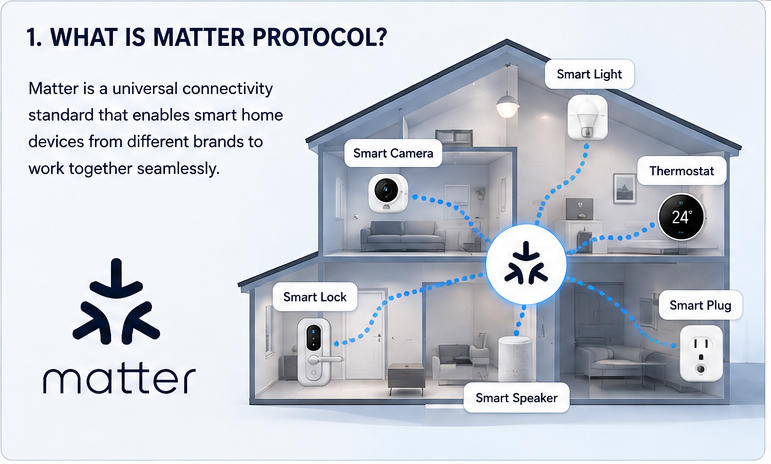
Matter is a free, open smart home connectivity standard, jointly developed and backed by Amazon, Apple, Google, and Samsung (along with hundreds of other manufacturers) through an organization called the Connectivity Standards Alliance. A device carrying the Matter certification works with Apple Home, Amazon Alexa, Google Home, and Samsung SmartThings simultaneously — without requiring separate versions, bridges, or workarounds for each platform.
That’s the elevator-pitch version. The rest of this guide fills in why that matters practically, because the short answer alone doesn’t explain why so many manufacturers, retailers, and reviewers — including us — have spent the last two years treating this as one of the most important developments in home technology.
Why Matter Had to Exist: A Short History of the Problem
To understand why Matter matters, it helps to understand the mess it was built to clean up.
The Fragmentation Era
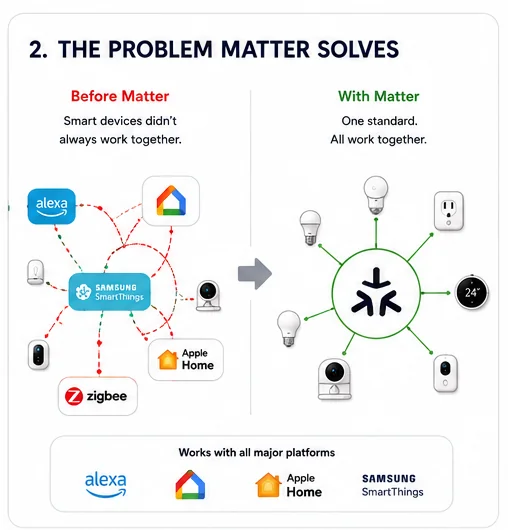
Through the 2010s, smart home technology grew explosively but chaotically. Amazon pushed Alexa. Google pushed its own assistant and later Google Home. Apple built HomeKit around strict hardware certification. Samsung ran SmartThings as yet another separate hub-based system. Beneath all of them sat multiple wireless protocols — Zigbee, Z-Wave, proprietary Wi-Fi implementations — each requiring its own bridge, hub, or app.
The practical result was a genuinely confusing shopping experience. A shopper walking into an electronics store, or scrolling Amazon, faced product badges everywhere: “Works with Alexa,” “Works with Google Assistant,” “HomeKit Enabled,” sometimes all three, sometimes just one. Buy the wrong bulb, and it simply wouldn’t talk to the speaker already sitting on your kitchen counter. Manufacturers, meanwhile, faced their own nightmare — building and certifying three or four separate versions of the same physical product to reach each ecosystem’s user base, multiplying cost and complexity.
The Turning Point
In December 2019, an unusual thing happened: Amazon, Apple, Google, and the Zigbee Alliance (which later renamed itself the Connectivity Standards Alliance) announced they would jointly develop a new, shared standard. Samsung joined shortly after. This was genuinely rare — direct competitors in one of tech’s most fiercely contested categories agreeing to build shared infrastructure rather than compete on lock-in.
The project was originally called “Project Connected Home over IP” (CHIP) before being rebranded as Matter ahead of its first public release in late 2022. Since then, adoption has accelerated steadily: by 2026, Matter certification has become close to a baseline expectation for any serious new smart home product, much the way USB-C became the expected charging standard after years of proprietary cables.
How Matter Actually Works
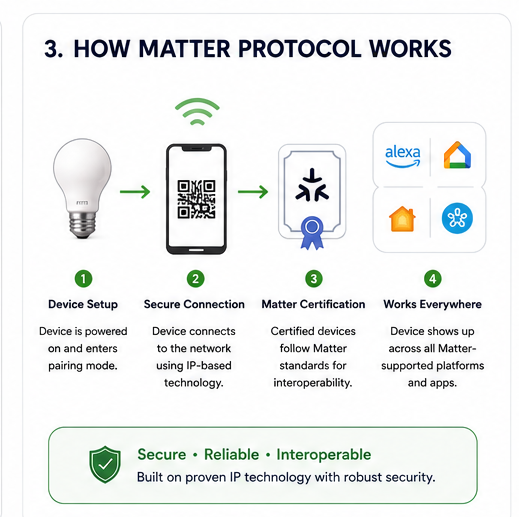
Understanding a little of the mechanics helps explain why Matter behaves differently from what came before — and why it delivers real, noticeable benefits rather than just a marketing badge.
It’s a Language, Not a Network
This is the most common point of confusion, so it’s worth being precise: Matter is not a wireless technology itself. It doesn’t replace Wi-Fi, Bluetooth, or Thread. Instead, Matter is an application layer — a shared “language” that devices speak on top of whatever network technology they use to physically connect.
Think of it like this: Wi-Fi and Thread are the roads, and Matter is the traffic law every vehicle agrees to follow regardless of which road it’s driving on. A Matter-certified bulb might connect via Wi-Fi; a Matter-certified sensor might connect via Thread; both speak the same Matter “language” once connected, which is what allows a single Apple Home, Alexa, Google Home, or SmartThings app to understand and control both.
Local Control Is the Real Breakthrough
Beyond cross-platform compatibility, Matter’s second major shift is architectural: commands run locally on your home network, not through a manufacturer’s distant cloud server.
Under the older model, a huge share of smart home commands — including from big-name brands — worked like this: your voice command reaches your speaker, travels over the internet to the manufacturer’s cloud servers, gets processed, and a response travels back down to your device. This round trip typically added noticeable delay, and critically, it meant your smart home partially stopped working the moment your internet connection dropped, even though the device you were trying to control was sitting three feet away.
Matter devices communicate directly across your local network using IP-based networking — the same fundamental technology your computer uses to talk to your printer. A command from your phone or voice assistant reaches the Matter device directly, without ever needing to leave your house. The results are measurable: faster response times (often near-instant versus a noticeable delay), and continued functionality during internet outages, since your local network keeps working even when your connection to the wider internet doesn’t.
Thread: Matter’s Favorite Traveling Companion
You’ll frequently see Matter mentioned alongside another term: Thread. They’re related but distinct, and the distinction is worth understanding.
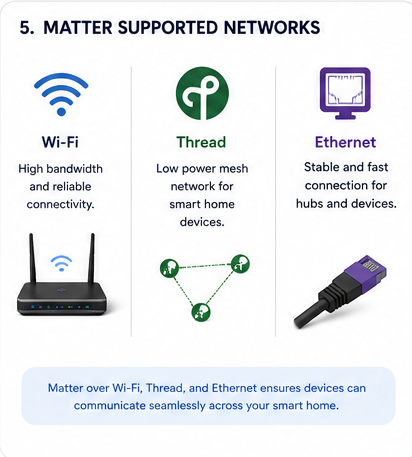
Thread is a low-power, mesh-networking wireless protocol — a physical way for small devices to talk to each other efficiently, similar in spirit to Zigbee but built with modern IP networking in mind. Matter can run over several different underlying connections (Wi-Fi, Ethernet, and Thread), but Thread is generally considered its best partner, particularly for battery-powered devices like sensors and locks, because it sips power far more efficiently than Wi-Fi radios do.
A crucial detail: Thread devices need a Thread Border Router somewhere on your network to bridge the Thread mesh to the rest of your home network and the internet. The good news is that this hardware is more common than most people realize — recent Apple TVs, HomePod minis, many newer Amazon Echo devices, and Google Nest Hub models all quietly function as Thread border routers. If you already own one of these, you likely have Thread coverage in your home without knowing it.
What Matter Actually Fixes for Everyday Buyers
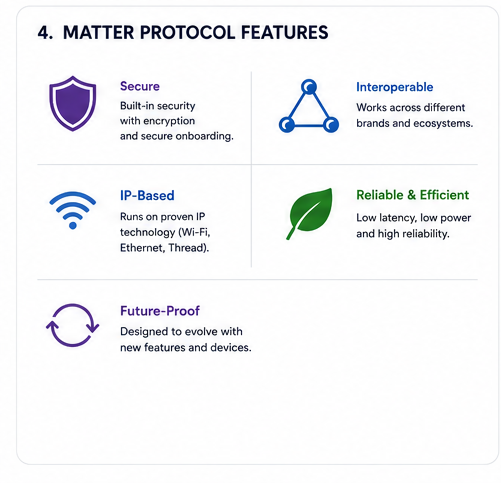
Stepping back from the technical mechanics, here’s what this translates to in practice — the reasons this genuinely matters for your next purchase.
1. You Stop Shopping by Ecosystem
Before Matter, choosing a smart bulb meant first answering “which voice assistant do I use?” and only then looking at products. With a Matter-certified device, that question mostly disappears. The same bulb works whether your household runs Alexa, Google Home, Apple Home, or SmartThings — and works across all of them simultaneously if your household is a mixed one, which is increasingly common as families combine an iPhone user with an Android user, or move between rental homes with different existing setups.
2. Mixed Households Stop Being a Compromise
This deserves its own callout because it’s one of Matter’s most immediately useful real-world benefits. Plenty of households aren’t uniformly Apple or uniformly Google — one partner has an iPhone, the other Android; the kids have whatever tablet was on sale; a smart speaker was a gift from a relative who didn’t check compatibility first. Pre-Matter, this meant either buying duplicate devices for different platforms or simply accepting that some family members couldn’t control certain devices from their preferred app. Matter devices are controllable from any certified platform’s app, resolving this friction entirely.
3. Your Smart Home Survives Internet Outages
Because Matter devices communicate locally, core functions — turning lights on, locking a door, checking a sensor’s status — continue working even if your internet service goes down. Voice commands through a cloud-dependent assistant may still be affected, but direct app control and pre-set automations keep running. For anyone who’s experienced their “smart” home suddenly turn dumb during an ISP outage, this is a meaningfully practical improvement, not just a technical nicety.
4. Response Times Improve
Local processing means less latency between your command and the device’s action. It’s a subtle difference in isolation, but noticeable in aggregate — automations feel snappier, voice commands execute with less of a pause, and multi-device scenes (like “goodnight,” which might involve a dozen devices) complete more smoothly.
5. Your Purchase Is More Future-Proof
Buying into a single-ecosystem device has always carried a quiet risk: what happens if you switch phones, or your household’s dominant platform changes? A Matter device sidesteps that risk almost entirely — it remains useful regardless of which platform you or a future household member prefers, and it will continue to benefit from an actively maintained, multi-billion-dollar-backed industry standard rather than a single company’s roadmap.
What Matter Does Not Do
It’s worth being equally clear about Matter’s boundaries, because overselling it does readers a disservice.
Matter does not eliminate the need for a controller entirely. You still need at least one “smart home hub” of sorts — practically speaking, this means an Echo device, Apple TV/HomePod, Google Nest speaker/display, or a SmartThings hub — acting as the local controller that ties your Matter devices together and bridges them to voice assistants and remote access. The good news is that many households already own one of these; Matter doesn’t require a new dedicated hub purchase in most cases.
Matter does not automatically make older devices compatible. A non-Matter smart plug you bought in 2021 doesn’t retroactively gain Matter support just because the standard exists — unless the manufacturer specifically issues a firmware update enabling it, which some brands have done for select existing products, but certainly not all.
Matter does not guarantee every feature works identically across platforms. While core functions (on/off, brightness, lock/unlock, sensor readings) are standardized, some manufacturer-specific advanced features may only be accessible through that brand’s own app, even on a Matter-certified device. A smart bulb’s basic color and brightness controls will work fine from any platform; a manufacturer’s proprietary “circadian rhythm” lighting mode might remain exclusive to their own app.
Modern smart speakers can also provide important smart-home infrastructure. For example, our Echo Dot Max vs Google Home Speaker comparison looks at two current speakers with Matter and Thread capabilities.
How to Identify Matter-Certified Products
Look for the official Matter logo — a stylized black-and-white mark that resembles a simplified home outline — on product packaging and Amazon listings. On Amazon specifically, look in the product title or the “About this item” bullet points for explicit mentions of “Matter” or “Matter-certified.” Reputable manufacturers also list supported platforms directly: Apple Home, Amazon Alexa, Google Home, and SmartThings, often with their own individual badges alongside the Matter one.
A word of caution worth flagging: some listings advertise “Matter compatible” loosely, meaning a firmware update is planned or partially rolled out, rather than “Matter certified,” meaning the device has passed the Connectivity Standards Alliance’s official certification testing today. When in doubt, check the manufacturer’s own product page (not just the Amazon listing) for explicit, current certification status before assuming full compatibility.
For a real-world smart-plug comparison, see our Kasa vs Gosund comparison.
Matter vs. The Old Standards: A Direct Comparison
| Features | Matter | Traditional Wi-Fi (pre-Matter) | Zigbee | Z-Wave |
|---|---|---|---|---|
| Works across all platforms | Yes, natively | No — locked to one ecosystem | Depends on hub | Depends on hub |
| Requires a hub | Often uses one you already own | No | Yes, dedicated | Yes, dedicated |
| Local control | Yes | Rarely | Yes | Yes |
| Works during internet outage | Yes | Usually no | Yes | Yes |
| Backed by | Apple, Amazon, Google, Samsung + hundreds more | Single manufacturer | Zigbee Alliance (now merged into CSA) | Z-Wave Alliance |
| Best for | Buyers wanting maximum flexibility | Buyers deeply committed to one ecosystem already | Larger installations needing mesh reliability | Similar to Zigbee, historically stronger in North America |
The practical takeaway from this table: Matter essentially absorbs the best qualities of hub-based systems (local control, reliability) while adding the universal compatibility that older Wi-Fi-only devices never offered.
Should You Prioritize Matter When Buying?
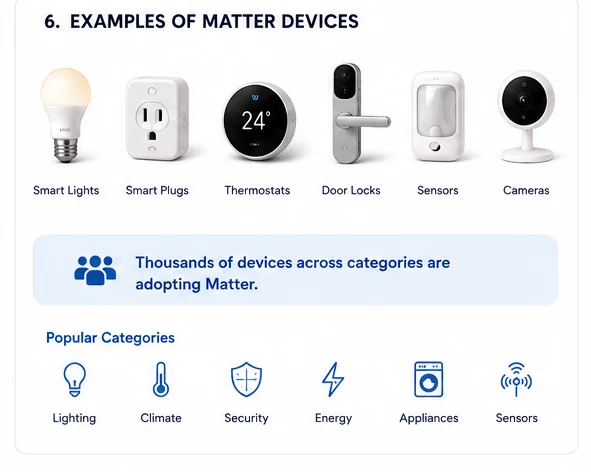
Our honest, practical guidance for shoppers:
Buy Matter when:
- Your household uses more than one voice assistant or phone ecosystem
- You want the best chance of long-term compatibility as your setup grows
- You value automations continuing to work during internet outages
- The Matter version costs about the same or only slightly more than the non-Matter equivalent (increasingly the norm)
A non-Matter device is still fine when:
- You’re deeply committed to a single ecosystem with no plans to change
- The non-Matter version is meaningfully cheaper and the product is something low-stakes (holiday lights, a spare lamp)
- You need a feature Matter doesn’t yet fully support well (advanced camera features, for instance)
In most of our own product recommendations across this site, we increasingly default to recommending Matter-certified options where the price difference is minor, precisely because the downside risk is so low and the upside — flexibility, speed, resilience — is consistently real.
The Bigger Picture: Where Matter Is Headed
Matter is a living standard, not a finished one. Since its 2022 launch, subsequent updates have progressively expanded support to new device categories — locks, thermostats, and more sensor types have been added over time, with cameras and more advanced device types expected in upcoming revisions. The Connectivity Standards Alliance continues to add member companies, and — perhaps the clearest signal of all — competing tech giants have kept investing in it rather than walking away, which is a meaningful vote of confidence in an industry not exactly known for cooperation.
For everyday buyers, the practical expectation is straightforward: the Matter badge will keep appearing on more product categories, prices for Matter-certified devices will keep converging with (and often matching) non-Matter equivalents, and the standard will likely become less something you actively shop for and more something you simply expect — the way nobody actively shops for “USB-C compatible” anymore; it’s just assumed.
Browse more of our smart home explainers and guides to keep building your foundational knowledge.
Frequently Asked Questions
Do I need to throw away my old smart home devices to use Matter?
No. Matter is designed to coexist with your existing setup rather than replace it. Your current Alexa, Google Home, or HomeKit devices continue working exactly as before. You can add Matter-certified devices alongside them, and in many cases, existing hub devices (an Echo, Apple TV, or Google Nest speaker) can serve as your Matter controller without any additional purchase. There’s no need to migrate or discard anything that already works for you.
Is Matter free, or does it cost extra to use?
Matter itself is a free, open standard — there’s no subscription fee or licensing cost passed on to you as a consumer for a device simply being Matter-certified. Any price difference you see between a Matter and non-Matter version of a similar product typically reflects manufacturing and certification costs on the brand’s side, and that gap has been narrowing steadily as adoption scales.
Which voice assistant works best with Matter?
All four major platforms — Apple Home, Amazon Alexa, Google Home, and Samsung SmartThings — support Matter devices, and the core experience (adding a device, basic control, automations) is comparable across them. The practical difference comes down to which platform’s app and voice assistant you personally prefer to use day-to-day, not which one “does Matter better,” since the underlying standard is identical across all four.
Can I control the same Matter device from two different apps at once — say, both Alexa and Apple Home?
Yes, and this is one of Matter’s most genuinely useful features for mixed households. A single Matter-certified device can be added to and controlled from multiple ecosystems simultaneously — one household member could control the same smart plug from their iPhone’s Home app while another controls it via Alexa on an Echo, with both apps staying in sync in real time.
Do I need a Thread border router to use Matter devices?
Not for every Matter device — it depends on which underlying connection type the specific product uses. Matter devices that connect via Wi-Fi don’t need Thread at all. Matter devices that connect via Thread (common for battery-powered sensors and locks, due to Thread’s power efficiency) do need a Thread border router somewhere on your network. Many households already own one without realizing it — recent Apple TVs, HomePod minis, several Echo models, and Google Nest Hub devices all function as Thread border routers automatically.
Is Matter more secure than older smart home standards?
Security was a core design priority for Matter from the outset, with built-in device authentication, encrypted local communication, and a formal certification process that includes security requirements. This doesn’t mean older standards were inherently insecure — reputable manufacturers on any protocol generally maintain solid security practices — but Matter’s security model was deliberately built with modern threats in mind rather than retrofitted onto older architecture, which is a genuine structural advantage.
Will Matter eventually replace Wi-Fi, Zigbee, and Bluetooth entirely?
No — and this is a common misconception. Matter operates on top of these existing wireless technologies rather than replacing them; it’s the shared language, not the network itself. Wi-Fi, Thread, and Bluetooth will continue serving as the underlying transport methods for the foreseeable future. What may gradually fade is the older application-layer fragmentation — proprietary, ecosystem-locked control systems — since Matter offers a shared, universal alternative at that layer.
How can I tell if a device I already own supports Matter?
Check the manufacturer’s official support page or app for firmware update announcements — many companies have retrofitted select existing products with Matter support via a software update rather than requiring a new purchase. Search “[your device name] + Matter update” for the most current status, since this changes frequently as manufacturers continue rolling out updates. If no such update has been announced, the device likely doesn’t support Matter and won’t unless the manufacturer specifically adds it.
Our Takeaway
Matter represents a genuinely rare moment in consumer technology: fierce competitors choosing to cooperate on shared infrastructure because the alternative — permanent fragmentation — was bad for everyone, including them. For anyone shopping for smart home devices, the practical upshot is straightforward: when a Matter-certified option exists at a comparable price to its non-Matter equivalent, it’s almost always the smarter buy. You get the same core functionality, plus genuine flexibility, faster local response, and resilience against internet outages — with essentially no meaningful downside.
It won’t make every buying decision for you, and plenty of excellent products still exist outside its scope. But increasingly, that small black-and-white badge on a product box is one of the more reliable, low-effort signals of a smart, future-proof purchase you’ll find in this category.

Ryan Hayes
Founder & EditorRyan Hayes is the founder and editor of Smart Space Advisor, where he researches and evaluates smart home technology to help readers make informed buying decisions. His work focuses on smart security, video doorbells, smart plugs, lighting, and connected-home platforms including Matter, Alexa, Google Home, and Apple Home. By combining product research, manufacturer documentation, feature comparisons, and real-world considerations, Ryan aims to cut through technical jargon and provide practical, straightforward advice about which smart home products offer genuine value.