
Amazon and Google have finally given smart-home buyers two genuinely modern compact speakers to choose from.
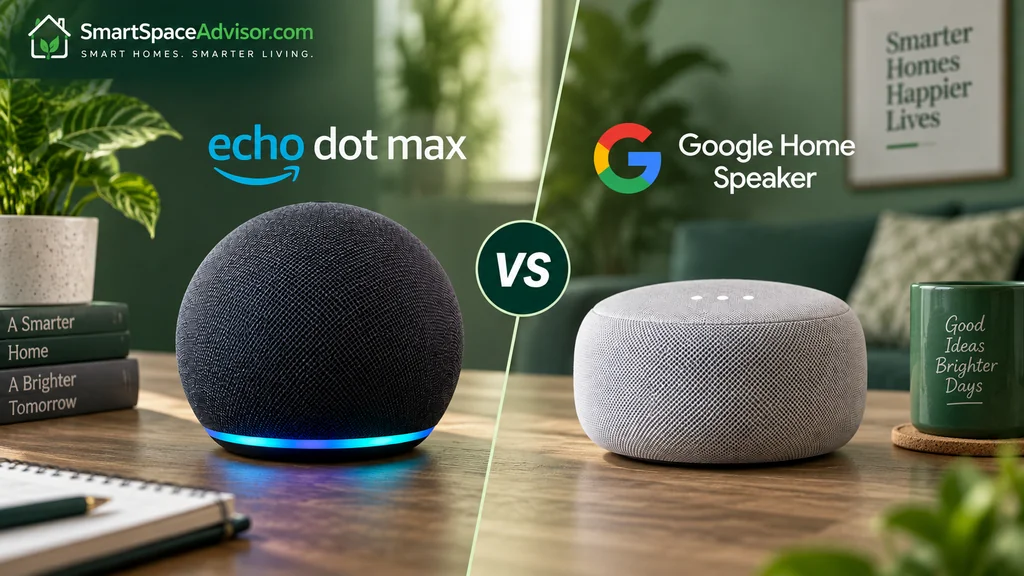
The Amazon Echo Dot Max combines upgraded audio with Alexa+, a built-in smart-home hub, Matter, Thread and Zigbee support. The Google Home Speaker takes a different approach, pairing Gemini for Home with Matter, Thread and tight integration with Google’s ecosystem.
Both can play music, answer questions and control a connected home. But they aren’t interchangeable.
The short version: choose the Echo Dot Max if smart-home connectivity, Alexa and stronger bass are your priorities. Choose the Google Home Speaker if you prefer Google Home and want Gemini’s more conversational assistant experience.
For many buyers, the ecosystem you already use will matter more than the relatively small difference in audio quality.
If you’re considering other options in this price range, see our guide to the best smart speakers under $100 for our top picks across Alexa, Google Home and other ecosystems.
Quick Verdict
Echo Dot Max: Best for Alexa users and anyone who wants the more capable built-in smart-home hub. See Echo Dot Max deals.
Google Home Speaker: Best for Google Home users and buyers who prioritize Gemini and conversational voice assistance. Google Home Speaker deals.
Our overall pick: Echo Dot Max for smart-home versatility — but the Google Home Speaker is arguably the better value at current regular pricing if the Dot Max is selling for substantially more than Google’s $99.99 price.
Echo Dot Max vs Google Home Speaker: At a Glance
| Feature | Echo Dot Max | Google Home Speaker |
|---|---|---|
| Voice assistant | Alexa / Alexa+ | Gemini for Home |
| Audio | Two-way system with woofer + tweeter | 58mm full-range driver |
| Microphones | 4* | 3 far-field microphones |
| Matter | Yes | Yes |
| Thread | Yes, Thread border router | Yes, Thread 1.3 border router |
| Zigbee hub | Yes | No |
| Smart-home hub | Matter + Thread + Zigbee | Matter + Thread |
| Sensors / ambient sensing | Omnisense | More limited |
| Wi-Fi | Wi-Fi connectivity | Wi-Fi 6, 2.4/5 GHz |
| Bluetooth | Yes | Bluetooth 5.4 |
| Best for | Alexa & smart-home enthusiasts | Google Home & Gemini users |
| Current price position | Regular price around $120; sales vary | $99.99 |
| Where to buy | Check on Amazon | Check on Amazon |
*Independent testing and published specifications report four microphones on the Echo Dot Max.
Winner at a glance: Echo Dot Max, primarily because of its broader smart-home connectivity. But Google has a strong advantage if you’re already invested in Google Home or want to stay around $100 without waiting for a sale.
What’s the Biggest Difference?
The biggest difference isn’t the speaker hardware.
It’s Alexa vs Gemini.
Amazon designed the Echo Dot Max around the newer Alexa+ experience and equipped it with unusually extensive smart-home hardware for such a compact speaker.
Google designed the Google Home Speaker specifically for Gemini for Home, with natural-language interaction at the center of the experience.
That means the decision becomes much easier when you ask yourself:
Which ecosystem do I want controlling my home?
If your lights, plugs, cameras, routines and household already revolve around Alexa, the Echo Dot Max makes more sense.
If you use Google Home, Google Calendar and other Google services heavily, the Google Home Speaker is the more natural choice.
Starting from scratch? Then the differences below matter considerably more.
Design and Build
These speakers follow broadly similar design philosophies: compact, fabric-covered devices intended to disappear into a room rather than look like traditional audio equipment.
The Echo Dot Max retains the rounded form associated with Amazon’s smaller Echo speakers, while the Google Home Speaker is a low, compact cylinder available in several colors.
Google currently offers the Home Speaker in Hazel, Porcelain, Berry and Jade, although some colors are market-specific. It measures approximately 3.4 inches high by 4.2 inches in diameter and weighs about 0.9 pounds.
Both are small enough for a nightstand, kitchen counter, office shelf or side table.
Which looks better?
That’s subjective.
Google’s design is understated and works particularly well if you prefer neutral home décor. Amazon’s Dot Max looks immediately familiar if you already have Echo devices around the house.
Design winner: Tie
Neither provides a compelling enough design advantage to choose one ecosystem over the other.
Sound Quality: Echo Dot Max vs Google Home Speaker
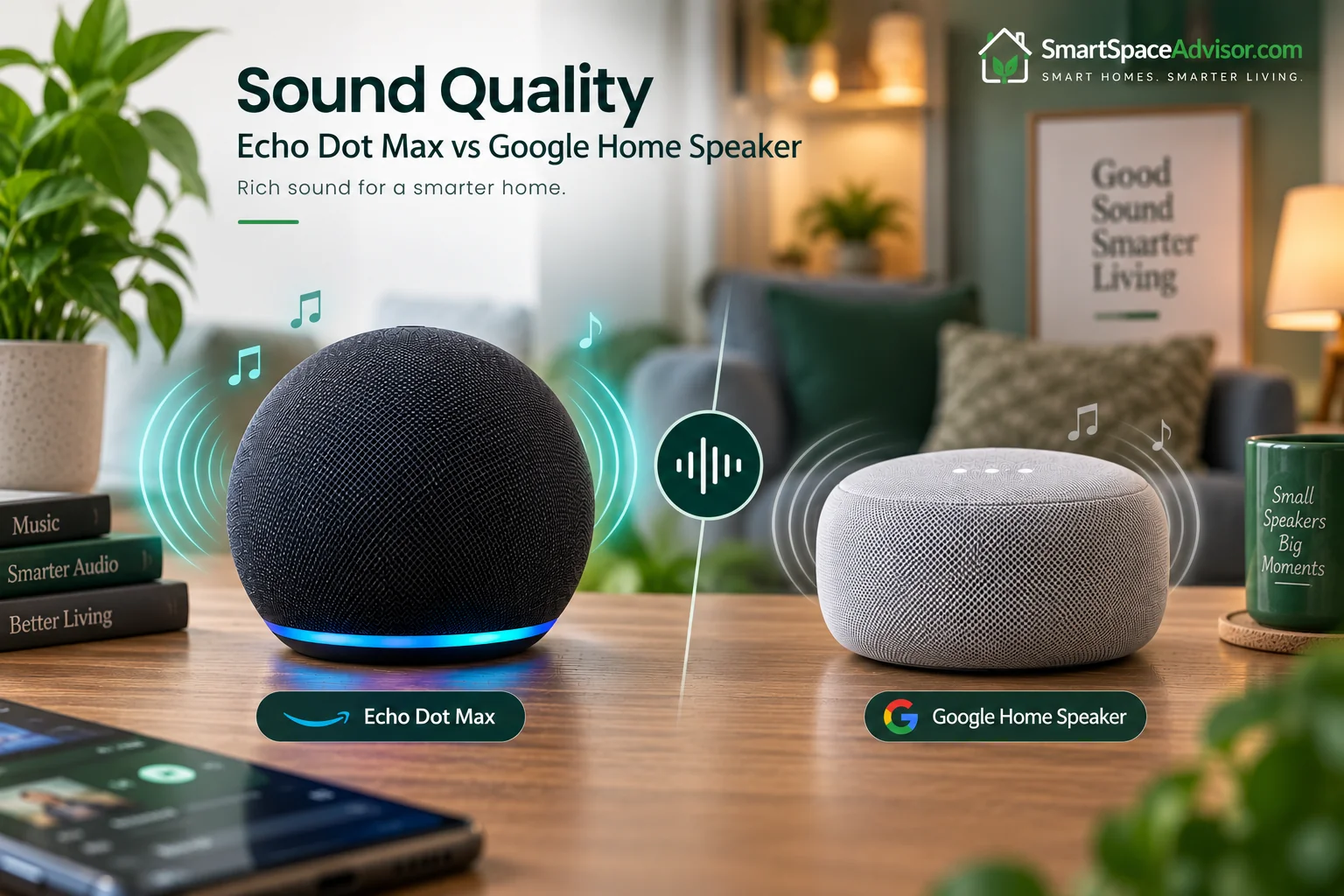
This is much closer than the specifications might suggest.
Echo Dot Max
Amazon made audio one of the main reasons to buy the Dot Max rather than a cheaper Echo Dot.
The Dot Max is the first Echo Dot built around a two-way speaker system, combining a high-excursion woofer with a dedicated tweeter. Amazon says the design produces nearly three times the bass of the fifth-generation Echo Dot.
It also uses automatic room adaptation to adjust playback according to the speaker’s surroundings.
The result is a compact smart speaker designed to provide substantially fuller audio than previous Dot models.
According to Amazon, it is the first Echo Dot with a two-way speaker system and delivers nearly three times the bass of the fifth-generation Echo Dot.
Google Home Speaker
Google takes a simpler hardware approach.
The Google Home Speaker uses a single 58mm full-range driver with omnidirectional sound.
A two-driver design sounds more impressive on a specification sheet, but that doesn’t automatically translate into a dramatic real-world difference.
Independent side-by-side testing has found these speakers surprisingly close. WIRED reported very similar overall sound between them, while Tom’s Guide gave the Dot Max a slight advantage, particularly for bass and midrange reproduction.
That makes our conclusion fairly straightforward.
Sound winner: Echo Dot Max — by a small margin
Buy the Dot Max if stronger bass and fuller compact-speaker audio are priorities.
But don’t choose Alexa solely because you’re expecting the Dot Max to completely outperform Google’s speaker. Independent comparisons suggest the difference is much smaller than the hardware configurations imply.
For background music, podcasts, kitchen listening and everyday smart-speaker use, both should be more than adequate.
For serious music listening, neither should be treated as a substitute for a larger dedicated speaker system.
Alexa+ vs Gemini for Home
This is where the comparison gets more interesting.
Traditional smart assistants often required users to learn specific commands:
“Turn on the living-room lamp.”
“Set thermostat to 72 degrees.”
“Play my kitchen playlist.”
The new generation of assistants is trying to make those interactions more conversational.
Alexa and Alexa+
The Echo Dot Max was designed for Amazon’s newer Alexa+ experience.
Amazon’s AZ3 custom silicon is intended to improve conversation detection and wake-word performance, while Alexa+ expands beyond traditional command-based Alexa interactions.
The Dot Max can still perform familiar Alexa functions such as controlling devices, creating routines, setting timers, playing music and answering questions.
Alexa+ adds more conversational AI capabilities on top.
Amazon currently includes Alexa+ with Prime membership, while access for users without Prime may involve a separate subscription depending on Amazon’s current offering.
Gemini for Home
The Google Home Speaker was built specifically around Gemini for Home.
Google’s emphasis is natural language.
Instead of carefully phrasing a command, Gemini is designed to interpret more conversational requests, including multiple instructions in one sentence.
For example, rather than issuing separate commands for every light, you could make a request along the lines of:
“Turn off the lights downstairs except the lamp beside the sofa.”
Gemini for Home is designed to interpret more natural, contextual smart-home requests rather than requiring rigid command phrasing.
Google also allows follow-up interactions and more natural corrections than traditional command-based smart assistants.
Some advanced Gemini for Home capabilities require Google Home Premium, so don’t assume every AI feature advertised across Google’s broader smart-home platform is included indefinitely with the speaker purchase.
Voice assistant winner: Google Home Speaker
For buyers primarily interested in the next generation of conversational voice assistance, Gemini is the more compelling reason to choose Google’s speaker right now.
That doesn’t make Alexa+ bad. The technology is evolving quickly on both sides.
But Google’s integration of Gemini is currently the Home Speaker’s strongest differentiator.
Smart-Home Control
If you’re buying one of these primarily as a smart-home controller, the advantage moves back toward Amazon.
Both speakers support Matter.
Both can participate in Thread-based smart homes.
But the Echo Dot Max goes further.
If smart plugs are among the first devices you’re adding, our best smart plugs guide compares options for Matter, energy monitoring, voice control and everyday automation.
Echo Dot Max Smart-Home Support
The Dot Max includes support for:
- Matter
- Thread
- Thread border-router functionality
- Zigbee
- Wi-Fi smart-home devices
- Bluetooth
- Alexa routines
- Omnisense-powered automation capabilities
Most importantly, Zigbee is built in.
That allows compatible Zigbee lights, plugs, locks and other devices to connect through the Echo’s built-in smart-home hub without requiring a separate Zigbee hub in supported configurations.
Amazon’s current developer documentation lists the Echo Dot Max as supporting both Zigbee 1.2/3.0 and Thread 1.3 border-router functionality.
That’s unusually capable connectivity for a compact speaker.
Google Home Speaker Smart-Home Support
Google’s speaker is also a proper smart-home hub.
It supports:
- Google Home
- Matter
- Thread 1.3 border-router functionality
- Wi-Fi 6
- Bluetooth 5.4
View the full specifications on Google’s official Google Home Speaker specs page.
That is enough for a modern Matter-focused smart home.
Google specifically lists the Home Speaker as a Matter hub for Google Home, while its Thread border router enables compatible Matter-over-Thread devices to join your home network.
What it doesn’t provide is the Dot Max’s native Zigbee hub.
Smart-home winner: Echo Dot Max
If you want one small speaker to serve as a flexible smart-home controller across newer Matter devices and older Zigbee hardware, Amazon has the advantage.
Matter and Thread: Which Is Better?
For Matter specifically, this comparison is close.
Both speakers support Matter.
Both can act as Thread border routers.
Google specifies Thread 1.3 for the Home Speaker, and Amazon’s current documentation also lists the Echo Dot Max as a Thread 1.3 border router.
That means either can form part of the infrastructure needed by compatible Matter-over-Thread products such as sensors, plugs, locks and lights.
One important clarification:
Matter does not mean every smart device works identically with every ecosystem.
Device categories, advanced features and manufacturer-specific functions can still vary between Alexa and Google Home.
So don’t choose based on the Matter logo alone.
Matter/Thread winner: Tie
For a primarily Matter-based home, both are strong hub choices.
Amazon wins the broader connectivity category because it adds Zigbee.
If you’re new to the standard, our guide to what Matter is and how it works explains how Matter connects devices across major smart-home ecosystems and where Thread fits in.
Zigbee: A Major Echo Dot Max Advantage
This deserves its own section because buyers often confuse Zigbee, Thread and Matter.
The Echo Dot Max has a built-in Zigbee hub.
The Google Home Speaker does not.
Why does that matter?
There are already large numbers of Zigbee smart-home products in homes today, including lights, plugs, switches, locks and sensors.
If you own compatible Zigbee devices — or expect to buy them — the Dot Max can potentially reduce the need for an additional hub.
However, don’t assume every Zigbee device exposes every manufacturer-specific feature when connected directly to Alexa. Some devices still work best through their manufacturer’s own bridge or app.
Zigbee winner: Echo Dot Max
No contest here.
Omnisense and Smart-Home Automation
Another differentiator is Amazon’s Omnisense platform.
Omnisense combines signals from compatible sensors and technologies to enable more context-aware Alexa automations.
Amazon says the Dot Max can use capabilities including audio, ultrasound, Wi-Fi-based sensing and other signals to help trigger smart-home experiences.
That opens the door to automations based on factors such as presence or environmental conditions rather than requiring every routine to begin with a spoken command.
Google’s speaker has touch controls and the core hardware required for its smart-home role, but Google does not list an equivalent collection of ambient smart-home sensors in its specifications.
Automation hardware winner: Echo Dot Max
If advanced home automation matters more than conversational AI, this strengthens Amazon’s case.
Microphones and Voice Recognition
The Google Home Speaker has three far-field microphones.
Published independent testing lists the Echo Dot Max with four microphones, and Amazon says its AZ3 chip improves conversation detection and background-noise filtering.
Numbers aren’t everything, though.
A speaker with more microphones doesn’t automatically hear you better in every room.
Independent testing of both devices has found strong voice pickup even while music is playing. WIRED’s direct comparison found Google’s three-microphone speaker consistently able to hear commands despite having one fewer microphone than the Dot Max.
Voice pickup winner: Tie
Both appear capable enough that microphone count shouldn’t determine your purchase.
Room acoustics, speaker placement, music volume and speaking distance can all affect real-world results.
Privacy Controls
Both Amazon and Google provide microphone privacy controls.
The Google Home Speaker includes a two-stage hardware microphone mute switch.
Amazon Echo devices provide microphone-off controls designed to disconnect the microphones electronically.
Beyond the physical controls, the bigger privacy decision is ecosystem-level.
A smart speaker uses always-available microphones to listen locally for its wake phrase before processing supported requests through its platform. Buyers concerned about privacy should review the voice-history, recording and data-management options offered by whichever ecosystem they choose.
Privacy winner: Tie
Neither speaker creates a decisive advantage here for the average buyer.
Music and Entertainment
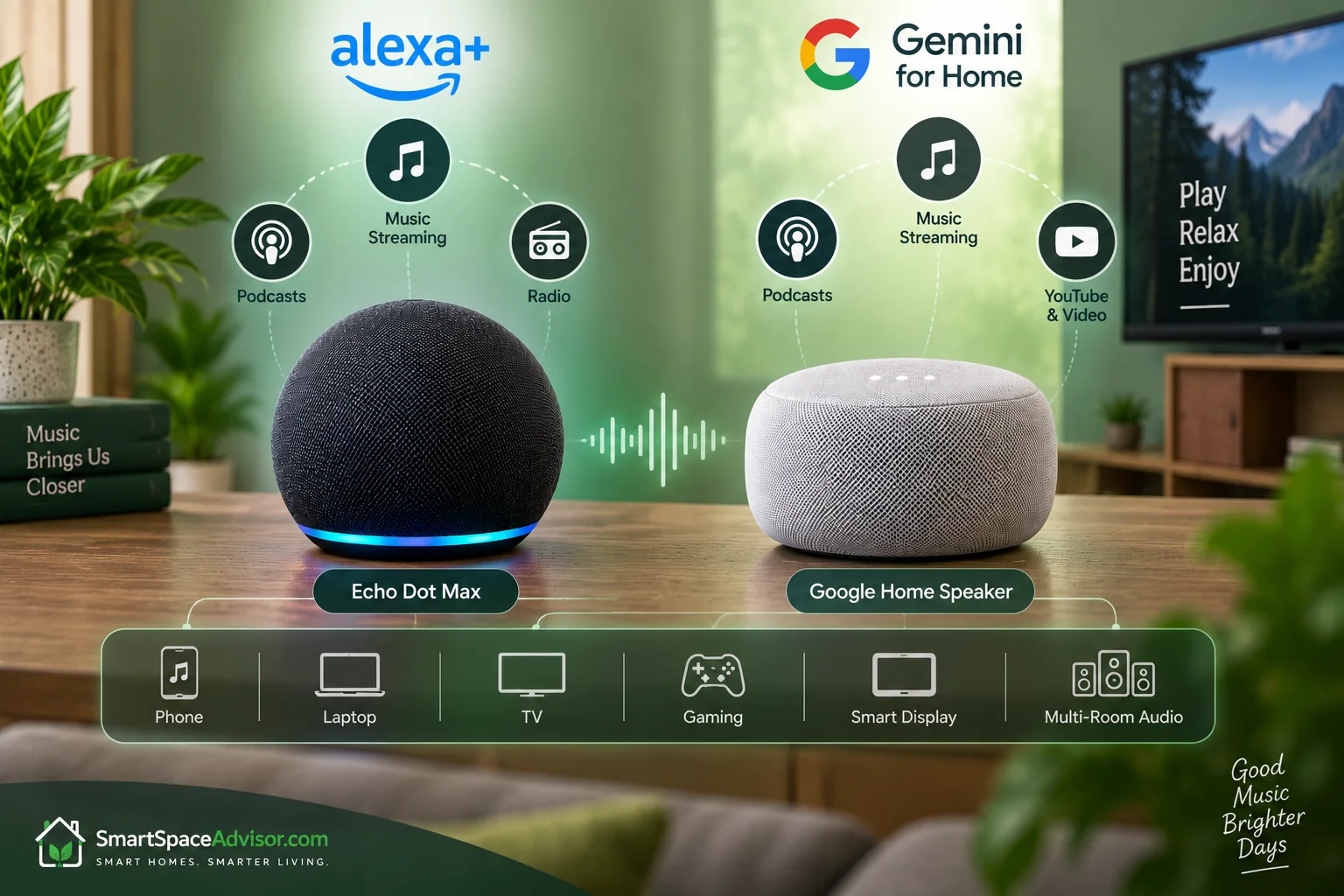
Both speakers support the mainstream use case most people expect:
“Play some music.”
Amazon naturally integrates tightly with Amazon’s services, while also supporting popular third-party audio services.
Google’s speaker fits naturally into households already using Google’s ecosystem and can also be paired with another Google Home Speaker for stereo audio.
Google also allows two Home Speakers to be paired with a Google TV Streamer for a home-theater audio setup.
Amazon offers its own multi-speaker and home-theater options within the Echo ecosystem.
Entertainment winner: Tie
Your existing services and other devices are more important than the speaker itself here.
Price and Value
This category has changed significantly.
The Echo Dot Max originally arrived at $99.99, putting it directly against Google’s $99.99 Home Speaker.
Amazon has since increased prices across a number of Echo devices. As of September 2026, the Dot Max’s regular price is around $120, although promotional pricing can still bring it below $100.
The Google Home Speaker remains listed by Google at $99.99 in the U.S.
That changes the value equation.
At the same price, we’d lean toward the Dot Max for buyers without an ecosystem preference because it combines good audio with Matter, Thread, Zigbee and additional sensing.
At $120 versus $99.99, however, Google’s value proposition becomes much stronger.
And if Amazon discounts the Dot Max back below $100?
The decision swings back toward Amazon for smart-home enthusiasts.
Value winner at regular price: Google Home Speaker
Value winner when Dot Max is discounted to around $100 or less: Echo Dot Max
Pricing note: Smart-speaker prices and promotions change frequently. Check the current selling price rather than relying solely on the original launch price.
Echo Dot Max Pros and Cons
Pros
- Strong sound for its compact size
- Better bass than previous Echo Dot models
- Dedicated woofer and tweeter
- Alexa and Alexa+ integration
- Matter support
- Thread 1.3 border router
- Built-in Zigbee smart-home hub
- Omnisense automation capabilities
- Strong option for an Alexa-centered smart home
Cons
- Regular price has increased
- More expensive than Google Home Speaker at current list pricing
- Alexa+ benefits are most attractive to Prime users
- Overkill if you only want basic voice commands and casual music
Google Home Speaker Pros and Cons
Pros
- Gemini for Home
- Natural conversational interactions
- Matter hub
- Thread 1.3 border router
- Wi-Fi 6
- Bluetooth 5.4
- Compact design
- Four color options
- Strong $99.99 regular-price positioning
- Excellent fit for existing Google Home households
Cons
- No built-in Zigbee hub
- Fewer smart-home sensing capabilities than Dot Max
- Single full-range driver
- Some advanced Gemini/Home capabilities require a subscription
- Less compelling if your household already revolves around Alexa
Which Should Alexa Users Buy?
Echo Dot Max.
There’s little reason for an established Alexa household to switch ecosystems solely for the Google Home Speaker.
The Dot Max provides the Alexa experience you’re already familiar with while adding better audio, Alexa+, Matter, Thread, Zigbee and a built-in smart-home hub.
It can also consolidate some smart-home infrastructure that might otherwise require separate hubs.
Winner for Alexa users: Echo Dot Max
Which Should Google Home Users Buy?
Google Home Speaker.
Again, ecosystem continuity wins.
You’ll get Gemini for Home, integration with your existing Google Home devices and automations, Matter hub functionality and a Thread border router without introducing another smart-home platform.
The Home Speaker is especially compelling if your household already uses Google services heavily.
Winner for Google Home users: Google Home Speaker
Which Is Better for a New Smart Home?
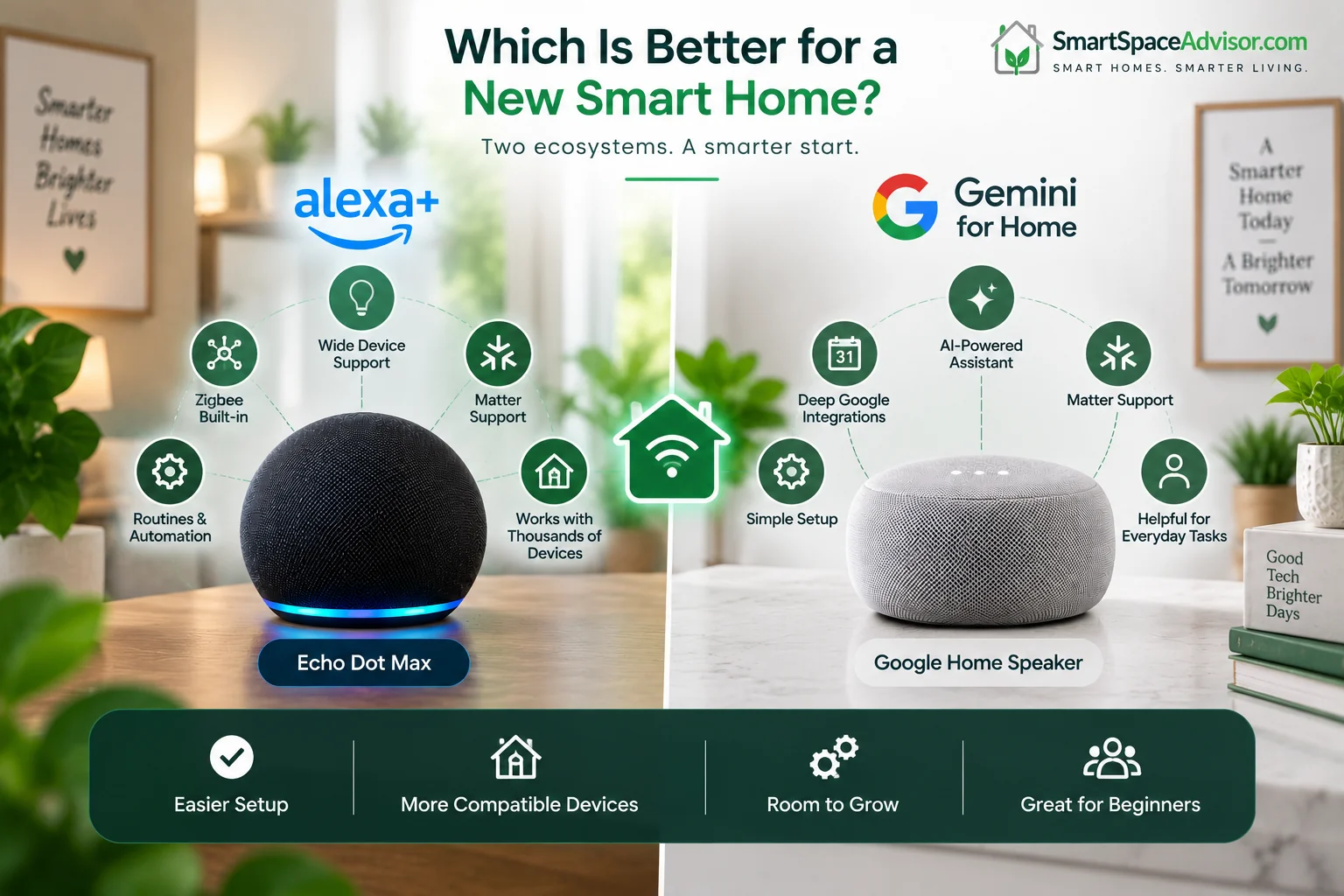
This is the hardest question.
If you’re starting from scratch and don’t care about Alexa versus Google, we’d give the Echo Dot Max a narrow hardware advantage.
Why?
Because it gives you:
Matter + Thread + Zigbee + additional sensing
in one compact device.
That gives you more flexibility when choosing smart-home hardware.
However, there’s an important qualification.
If the Echo Dot Max costs around $120 while Google’s speaker remains $99.99, the extra hardware needs to be useful to you.
If you’re building a new home almost entirely around Matter devices and don’t need Zigbee, Google’s speaker becomes extremely attractive.
Starting from scratch? Our how to set up a smart home from scratch guide walks through choosing an ecosystem, adding your first devices and building useful automations step by step. You also don’t need to spend hundreds of dollars immediately. Our guide to the best budget smart home devices under $50 covers inexpensive ways to start expanding your setup.
Our recommendation
Choose Dot Max if you expect to build a more advanced or mixed-protocol smart home.
Choose Google Home Speaker if you’re building around Matter and prioritize AI assistance and value.
Which Is Better for Music?
Echo Dot Max — narrowly.
Its two-way design and stronger bass give it an advantage, and independent side-by-side testing has also given Amazon a slight edge in some listening comparisons.
But the gap isn’t large enough that we’d recommend switching ecosystems just for audio.
If music quality is your number-one priority and you have room in your budget, you may be better served by looking beyond compact $100-class smart speakers altogether.
Which Is Better for Voice Assistance?
Google Home Speaker.
Gemini for Home is the main reason.
Google’s emphasis on natural language, multi-part commands, corrections and conversational context makes the Home Speaker particularly interesting for buyers who want more than traditional command-and-response smart-home control.
Alexa+ is evolving in the same general direction, so this is one category worth reassessing as both platforms receive software updates.
Echo Dot Max vs Google Home Speaker: Our Scorecard
| Category | Winner |
|---|---|
| Design | Tie |
| Sound quality | Echo Dot Max |
| Bass | Echo Dot Max |
| Conversational AI | Google Home Speaker |
| Alexa households | Echo Dot Max |
| Google households | Google Home Speaker |
| Matter | Tie |
| Thread | Tie |
| Zigbee | Echo Dot Max |
| Smart-home hub | Echo Dot Max |
| Automation hardware | Echo Dot Max |
| Voice pickup | Tie |
| Privacy controls | Tie |
| Regular-price value | Google Home Speaker |
| Overall smart-home versatility | Echo Dot Max |
Echo Dot Max vs Google Home Speaker: Final Verdict
There isn’t a universally better speaker here — and that’s precisely why this comparison comes down to more than sound quality.
The Echo Dot Max is our pick for smart-home versatility. Matter, Thread, Zigbee and Amazon’s additional sensing capabilities make it a particularly powerful hub for a compact speaker. Its two-way audio system also gives it a small sound-quality advantage.
The Google Home Speaker is our pick for conversational intelligence and current regular-price value. Gemini for Home feels central to the product rather than an add-on, while Matter and Thread give Google users the infrastructure needed for a modern connected home.
Buy the Echo Dot Max if:
- You use Alexa
- You own or plan to buy Zigbee devices
- You want a built-in smart-home hub
- Stronger bass matters
- You want more automation hardware
- You find it discounted near or below $100
Buy the Google Home Speaker if:
- You use Google Home
- You prefer Gemini
- Natural voice interaction matters
- You’re building primarily around Matter and Thread
- You don’t need Zigbee
- The Dot Max is significantly more expensive
Our overall winner: Echo Dot Max — with conditions
At similar prices, we’d choose the Echo Dot Max.
Its broader smart-home connectivity and slightly stronger audio make it the more versatile piece of hardware.
But at today’s regular pricing, the decision is closer. If the Echo Dot Max is around $120 and the Google Home Speaker is $99.99, Google offers excellent value — particularly for a Matter-based smart home.
And if you’re already committed to either Alexa or Google Home, stay with your ecosystem unless you have a specific reason to switch. The benefits of maintaining one coherent smart-home platform are more important than the relatively small differences between these two speakers.
Frequently Asked Questions
Is the Echo Dot Max better than the Google Home Speaker?
The Echo Dot Max is more versatile as a smart-home hub because it supports Matter, Thread and Zigbee, while also offering a two-way speaker system and Amazon’s Omnisense capabilities. The Google Home Speaker is the stronger choice for Gemini, Google Home integration and current regular-price value.
Which sounds better, Echo Dot Max or Google Home Speaker?
The Echo Dot Max has a slight advantage. Its dedicated woofer and tweeter provide stronger bass, and independent comparisons have generally found Amazon to have a small audio edge. The difference isn’t dramatic, however.
Does the Google Home Speaker support Matter?
Yes. Google lists the Home Speaker as a Matter hub for Google Home. It also includes a Thread 1.3 border router for compatible Matter-over-Thread devices.
Does Echo Dot Max support Matter?
Yes. The Echo Dot Max supports Matter and includes Thread border-router functionality.
Does Echo Dot Max have Zigbee?
Yes. The Echo Dot Max includes a built-in smart-home hub that supports compatible Zigbee devices. This is one of its biggest advantages over the Google Home Speaker.
Does the Google Home Speaker have Zigbee?
No. Google’s published specifications list Matter and Thread support but not a built-in Zigbee hub.
Is Gemini better than Alexa+?
They have different strengths and both continue to evolve. Gemini currently has an advantage for natural conversational interactions, while Alexa’s broader smart-home ecosystem and the Dot Max’s hub hardware make Amazon particularly attractive for home automation.
Do I need a subscription for either speaker?
Basic smart-speaker and smart-home functionality does not require a separate paid AI subscription, but some advanced AI features can depend on subscriptions. Alexa+ is included with Amazon Prime under Amazon’s current model, while certain advanced Gemini for Home features require Google Home Premium. Subscription terms can change, so check the current offering before purchasing.
Which speaker is better for Matter devices?
Both are strong choices. Both support Matter and can act as Thread border routers. The better choice depends primarily on whether you prefer Alexa or Google Home.
Which should I buy if I’m starting a smart home from scratch?
The Echo Dot Max offers greater protocol flexibility because it combines Matter, Thread and Zigbee. The Google Home Speaker is an excellent alternative if you plan to build primarily around Matter and want Gemini or a lower regular purchase price.
Our Research & Evaluation Approach
Smart Space Advisor evaluates smart-home products based on the factors that matter most in everyday use: compatibility, smart-home connectivity, assistant capabilities, audio hardware, privacy controls, ongoing costs and overall value.
For this comparison, specifications and compatibility were checked against current Amazon and Google documentation. We also considered independent side-by-side testing to understand differences that specifications alone cannot establish, particularly sound quality and microphone performance.
We do not present research-based evaluation as hands-on testing. Where we have not personally tested a device, our conclusions are based on manufacturer documentation, reliable independent testing and the practical differences between the products.
Pricing, specifications, subscriptions and compatibility checked September 2026. These details can change after publication.

Ryan Hayes
Founder & EditorRyan Hayes is the founder and editor of Smart Space Advisor, where he researches and evaluates smart home technology to help readers make informed buying decisions. His work focuses on smart security, video doorbells, smart plugs, lighting, and connected-home platforms including Matter, Alexa, Google Home, and Apple Home. By combining product research, manufacturer documentation, feature comparisons, and real-world considerations, Ryan aims to cut through technical jargon and provide practical, straightforward advice about which smart home products offer genuine value.