
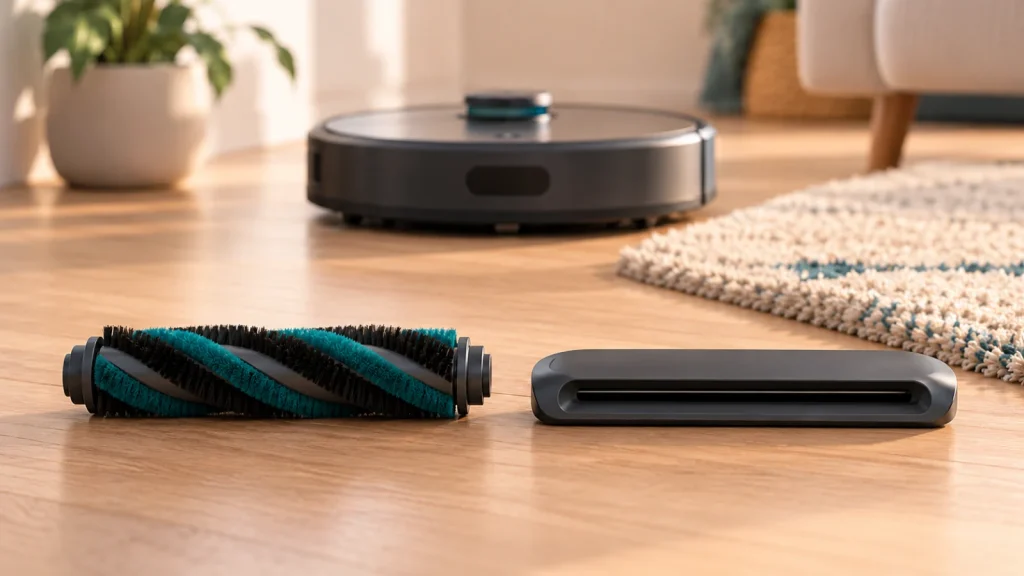
Choosing a robot vacuum with or without a brush roll depends on the floors and debris you need it to clean. A rotating main brush provides contact with the floor and can help loosen material from carpet. A suction-only opening removes that central roller as a place for hair to wrap, but it also changes how the robot tackles embedded dirt.
Neither design is automatically best for every pet household. Loose fur on tile, long human hair around furniture and hair pressed into a rug are different cleaning problems. Start with the surface where most of your troublesome debris actually ends up.
Identify the part being compared
A main brush roll sits across the robot’s central cleaning opening. Depending on the design, it may have bristles, flexible rubber elements or a combination. Some robots use two main rollers rather than one.
A suction-only design has an opening without that rotating central brush. It may still have side brushes that sweep material toward the inlet, along with wheels and other moving parts. “No brush roll” therefore does not mean that the underside contains nothing that can collect hair.
Also separate the cleaning head from the motor. A “brushless motor” describes how a motor operates internally. It does not mean the vacuum lacks a floor-cleaning brush. Texas Instruments’ brushless-DC motor explanation discusses electronic commutation; that terminology concerns the motor, not whether a roller touches your carpet.
When a listing uses “brushless,” inspect the underside photograph and manual. Establish whether it means a motor specification, a suction-only inlet or simply marketing language that needs clarification.
Compare the ownership differences
| Design | What it changes | Potential benefit | Compromise to investigate |
|---|---|---|---|
| Bristle or mixed main roller | Adds rotating contact with the floor | Can help disturb debris within carpet | Hair removal, brush wear and floor compatibility |
| Rubber main roller or rollers | Uses flexible cleaning elements | Offers a different surface for debris handling and maintenance | Hair can still gather around ends and bearings |
| Suction-only central opening | Removes the rotating main roller | Eliminates central-roller detangling | Pickup of embedded material, especially on carpet |
These descriptions explain mechanisms and maintenance, not a universal performance ranking. The overall cleaning head, airflow and route can make two robots with similar-looking rollers perform differently.
Why carpet changes the decision
Carpet holds debris within and between fibers. A robot can collect some material sitting on top while leaving embedded dirt behind. A clean-looking pass is therefore not the same assessment as a controlled carpet deep-cleaning test.
Mechanical agitation is relevant because it helps disturb material before airflow carries it into the vacuum. Dyson’s explanation of cleaning pet hair distinguishes agitation created through airflow from active agitation produced by brush contact. That explains the mechanism, but it does not prove that every brush-equipped robot outcleans every suction-only model.
For a home where rugs and fitted carpet are the main difficulty, look for independent tests of embedded dirt and carpet hair on the exact robot. Do not substitute a video of cereal being collected from tile, a suction-pressure claim or an anti-tangle demonstration for that evidence.
The ILIFE V2 is a useful specific example. In Vacuum Wars’ own V2 testing, its suction-only design produced useful hard-floor pickup but struggled with embedded carpet dirt and hair. Those results support treating that model as a specialized hard-floor option. They do not establish a measured result for every robot without a roller.
If your main complaint is fur worked into a living-room rug, reducing roller maintenance may be the wrong first priority. You could trade away the cleaning capability you need and still have to use a conventional vacuum regularly on that rug. For model-by-model hair-pickup and tangle comparisons, see our best robot vacuums for pet hair guide.
When suction-only cleaning can make sense
On predominantly hard floors, loose hair and everyday debris create a different task. A central roller is no longer the only obvious consideration; the ability to reach the debris, move it toward the opening and collect it without excessive scattering matters too.
Removing the central roller eliminates a particular maintenance job: pulling wrapped hair from that roller. That can be appealing when long hair is common and most cleaning takes place on tile or another compatible hard surface.
However, inspect the rest of the design. Side brushes, caster wheels and wheel axles can still need attention. The inlet can become blocked, the bin can fill and the filter still requires the care specified by the manufacturer. Suction-only is a change in maintenance, not an absence of maintenance.
Consider the proportion of floor that really needs help. A home with hard floors and one rarely used rug is a different case from one where the only hard floor is the kitchen. Base the decision on the work you expect the robot to perform, rather than the material covering the largest unused area.
Pet hair: evaluate where it lands and how it behaves
The label “for pet hair” can conceal several distinct tasks. You may need to collect loose fur before it gathers along skirting boards, lift hair from carpet, manage a heavy daily shedding load or reduce the amount of detangling you personally perform.
Write down your main problem before comparing products. For example: “I need loose hair collected from the kitchen each evening” is a more useful requirement than “I need the best pet vacuum.” It directs attention to hard-floor pickup, access around furniture and bin maintenance.
For carpeted pet areas, prioritize evidence about hair embedded in carpet. For long human hair on hard floors, look closely at how owners access the main roller ends, side brushes and wheels. For heavy shedding, consider the complete debris path and emptying arrangements as well as the brush.
An anti-tangle feature should be evaluated under the conditions actually tested. Hair length, floor type, load and test duration matter. A demonstration showing one clean roller after one run does not establish that every part remains free of hair over normal ownership.
Rubber rollers still need inspection
Rubber cleaning elements can look easier to wipe than a dense bristle brush, but material alone does not settle cleaning performance or maintenance effort. Check whether the ends detach, how the roller locates in the cleaning head and whether replacement parts are available.
iRobot’s Roomba s9 brush-care instructions specifically include checking brush ends, bearings and the vacuum path. That is a useful reminder that hair management extends beyond the visible cleaning surface of a rubber roller.
Do not assume a rubber brush can be washed or that its end components can be pried apart. Follow the instructions for the exact assembly. Our robot-vacuum maintenance guide explains how to approach those checks without treating every model as mechanically identical.
More side brushes do not automatically mean better cleaning
Side brushes help move material from edges toward the cleaning opening, but counting them is not a substitute for evaluating pickup. Their positioning, movement and interaction with the robot’s route matter.
Eufy explains in its side-brush design guidance that navigation and design choices influence the number of brushes used. That supports asking how the whole robot behaves along an edge rather than assuming two is always better than one.
When observing a robot in your home, watch what happens to loose debris around corners and chair legs. Does it reach the opening, get scattered or remain untouched? That observation addresses the task you care about more directly than a component count.
Do not let suction numbers decide the comparison
Advertised pressure figures tell you something about a manufacturer’s stated suction capability under its test conditions. They do not by themselves describe how a complete robot collects debris from your floor.
Ask for evidence about the outcome: hard-floor debris pickup, embedded carpet dirt and hair collection. Keep those results separate. An excellent result on one task does not automatically establish an equally strong result on another.
Also check whether you are comparing like-for-like tests. Percentages produced by different publications may use different debris, flooring, run lengths and scoring methods. It is more responsible to explain what each test showed than to combine unrelated figures into a precise ranking.
Smart Space Advisor has not conducted a controlled brush-roll-versus-suction-only experiment for this article. The comparisons here use documented designs, attributed independent findings and the practical consequences for ownership.
A roller cannot remove dirt from a patch the robot never visits. Equally, a neat route cannot guarantee that the cleaning head removes every kind of debris it passes over. Coverage and pickup are connected tasks that still need separate assessment.
If a suction-only model also uses basic navigation, do not attribute every missed patch to the absence of a brush. If a mapped robot leaves material along a wall, do not assume its map is wrong. Look at whether the robot reached the patch and what happened when it did.
Our navigation guide explains random, gyroscope-assisted and LiDAR systems. Use it alongside this hardware comparison when deciding what a more expensive model would actually add.
Choose for one of these common situations
Mostly hard floors, loose hair and a dislike of detangling
A suction-only opening is worth investigating, provided exact-model hard-floor evidence and the remaining maintenance suit you. Confirm how the side brushes and wheels are cleaned, and keep realistic expectations for any carpeted area.
A mixed home with several everyday rugs
A brush-equipped model is the more useful place to start your research. Check rug compatibility and independent pickup evidence. Do not assume that a roller suitable for an ordinary rug is automatically appropriate for delicate fibers, fringes or a high-pile surface.
Carpet is the main problem
Prioritize carpet-cleaning evidence and the ability to maintain the brush properly. A simpler maintenance design is not a good trade if it leaves you doing most of the intended cleaning yourself. Check your carpet manufacturer’s care guidance too.
You are choosing mainly for convenience
Compare the entire routine: bin emptying, accessible brush ends, replacement parts and the frequency of intervention. A self-emptying dock addresses one job; it does not by itself untangle a brush, clear an inlet or make a filter maintenance-free.
A short checklist before ordering
Inspect the underside diagram, identify the main cleaning opening and read the maintenance instructions. Find evidence for your main floor-and-debris combination. Check that compatible replacement brushes, filters and other necessary parts can be obtained for the exact model.
During the return period, observe normal cleaning rather than creating an artificial mess that the manual excludes. Note where hair collects and how long routine care takes. Then decide whether the cleaning benefit and remaining work match what you bought the robot to do.
For specific app-free and offline options, our robot-vacuum buying guide places cleaning hardware alongside control and scheduling requirements. Choose the combination that solves your actual floor problem; “no brush roll” and “anti-tangle” are useful design descriptions, not complete buying decisions.

Ryan Hayes
Founder & EditorRyan Hayes is the founder and editor of Smart Space Advisor, where he researches and evaluates smart home technology to help readers make informed buying decisions. His work focuses on smart security, video doorbells, smart plugs, lighting, and connected-home platforms including Matter, Alexa, Google Home, and Apple Home. By combining product research, manufacturer documentation, feature comparisons, and real-world considerations, Ryan aims to cut through technical jargon and provide practical, straightforward advice about which smart home products offer genuine value.