
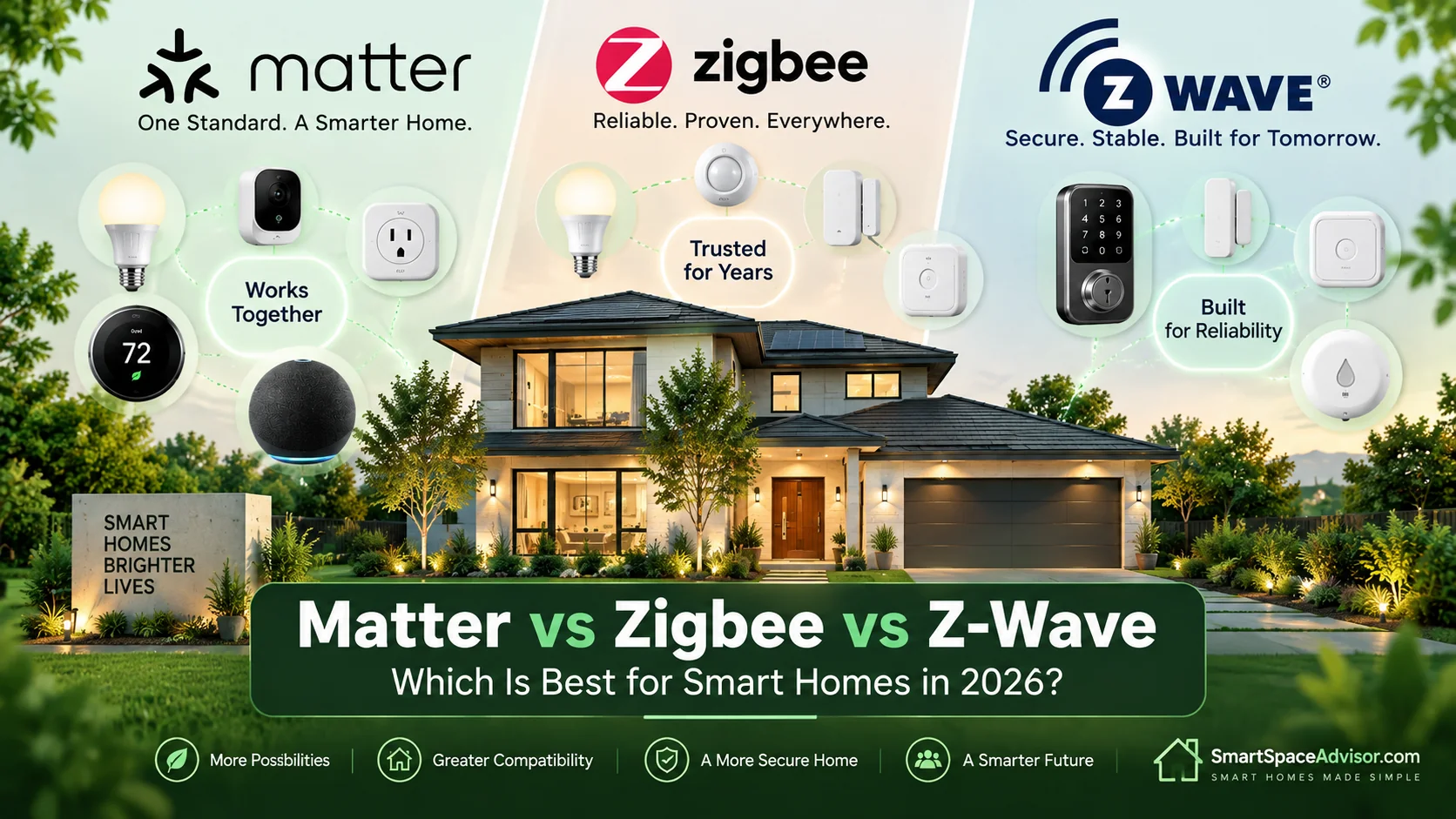
If you’re building a smart home in 2026, you’ll probably encounter Matter, Zigbee and Z-Wave. They all connect smart-home devices, but they don’t work in quite the same way.
Matter is an IP-based interoperability standard, while Zigbee and Z-Wave are wireless connectivity technologies with their own networks. Matter commonly works over Wi-Fi, Thread or Ethernet, whereas Zigbee and Z-Wave create dedicated smart-home networks. If you’re new to Matter, read our guide to what Matter is and how it works for a complete explanation.
So which should you choose?
For most new smart homes, Matter is the best starting point for broad ecosystem compatibility. Zigbee remains excellent for low-power devices such as sensors and lighting, while Z-Wave is a strong choice for dedicated automation, locks and security devices.
In this guide, we’ll compare Matter vs Zigbee vs Z-Wave for compatibility, hubs, range, mesh networking, reliability, security and everyday smart-home use.
Quick Verdict
Choose Matter when broad ecosystem compatibility and future flexibility are your priorities. Choose Zigbee when you want a mature low-power mesh ecosystem with a huge installed base. Choose Z-Wave when you value a dedicated sub-GHz smart-home network, certified interoperability and strong options for security and automation devices.
Standards, specifications and compatibility information checked September 2026.
Matter vs Zigbee vs Z-Wave: Quick Comparison
| Feature | Matter | Zigbee | Z-Wave |
|---|---|---|---|
| What is it? | IP-based interoperability/application standard | Wireless IoT connectivity stack | Wireless smart-home connectivity stack |
| Common networking | Wi-Fi, Thread, Ethernet | Primarily 2.4 GHz mesh; newer Zigbee also supports sub-GHz options | Sub-GHz; traditional mesh plus Z-Wave Long Range |
| Requires a hub? | Depends on device and ecosystem | Usually requires a compatible coordinator/hub | Usually requires a compatible controller/hub |
| Mesh networking | Depends on transport; Thread is mesh | Yes | Yes for traditional Z-Wave |
| Low-power devices | Excellent over Thread | Excellent | Excellent |
| Wi-Fi interference | Matter-over-Wi-Fi uses Wi-Fi; Matter-over-Thread uses 2.4 GHz 802.15.4 | Possible on 2.4 GHz deployments | Less exposed to 2.4 GHz Wi-Fi interference |
| Cross-platform focus | Major strength | Depends on hub/platform | Depends on hub/platform |
| Existing device ecosystem | Growing rapidly | Very large and mature | Mature |
| Best for | Cross-platform smart homes | Sensors, bulbs, switches and established hub ecosystems | Locks, sensors, switches and dedicated automation networks |
| Can coexist with Matter? | — | Yes, through compatible Matter bridges | Yes, through compatible Matter bridges |
The most important row is the first.
Matter isn’t simply “new Zigbee” or “new Z-Wave.”
The technologies solve overlapping but different problems.
What Is Matter?
Matter is an open, IP-based smart-home standard developed through the Connectivity Standards Alliance (CSA) with participation from companies across the smart-home industry.
Its main goal is interoperability.
Instead of a manufacturer building completely separate integrations for Alexa, Apple Home, Google Home, SmartThings and other ecosystems, Matter provides a standardized way for supported device types and platforms to communicate.
Matter uses established IP networking technologies rather than creating its own radio system.
A Matter device can communicate over:
- Wi-Fi
- Thread
- Ethernet
Bluetooth Low Energy is also used during the device-commissioning process.
That means saying “Matter uses Thread” isn’t always correct.
Some Matter devices use Thread.
Others use Wi-Fi.
Some wired products can use Ethernet.
Matter 1.6 in 2026
Matter continues to evolve.
Matter 1.5, released in November 2025, added major capabilities including camera support, improved closure support, soil sensors and expanded energy-management features.
The Connectivity Standards Alliance followed that with Matter 1.6 in June 2026.
Rather than focusing on a large expansion of device categories, Matter 1.6 improves areas such as commissioning, multi-ecosystem device management and context-aware control.
This is worth mentioning because older articles that describe Matter solely based on its early releases no longer represent the full standard.
What Is Zigbee?
Zigbee is a mature, low-power wireless IoT technology maintained through the Connectivity Standards Alliance.
Unlike Matter, Zigbee includes the networking technology needed to create its own wireless network.
For years, Zigbee has been especially common in:
- smart bulbs
- motion sensors
- contact sensors
- switches
- plugs
- buttons
- thermostats
- other low-power smart-home devices
Traditional consumer Zigbee deployments commonly use the 2.4 GHz band and IEEE 802.15.4 radio technology.
Zigbee uses a self-organizing, self-healing mesh network. Compatible mains-powered devices can help extend the network by relaying communications, while battery-powered end devices can remain optimized for low power consumption.
The Connectivity Standards Alliance says more than a billion Zigbee chipsets have been sold, giving the technology an enormous existing footprint.
Zigbee Is Still Evolving
It would be wrong to describe Zigbee as an obsolete technology that Matter has already replaced.
Zigbee continues to evolve.
The current generation includes Zigbee 4.0 and the new Suzi sub-GHz technology. In September 2026, the CSA opened product certification for Suzi, which is designed to extend Zigbee into longer-range, low-power applications beyond its traditional 2.4 GHz footprint.
So while Matter receives more consumer attention today, Zigbee remains an actively developed technology.
What Is Z-Wave?
Z-Wave is a wireless connectivity technology designed specifically around control, monitoring and smart-home/IoT applications.
Traditional Z-Wave uses sub-1 GHz frequencies, with the exact operating frequencies depending on the region.
That is a significant difference from common 2.4 GHz Zigbee networks.
Because traditional Z-Wave doesn’t occupy the same 2.4 GHz band used by Wi-Fi, Bluetooth and many Zigbee devices, it avoids that particular source of radio congestion.
Z-Wave has been used extensively for devices such as:
- smart locks
- motion sensors
- contact sensors
- switches
- dimmers
- thermostats
- garage-door controls
- leak sensors
- security equipment
The Z-Wave Alliance emphasizes certification and backwards compatibility as core parts of the ecosystem. It currently reports more than 4,500 interoperable products in the Z-Wave ecosystem.
Z-Wave Long Range
Modern Z-Wave also includes Z-Wave Long Range (ZWLR).
This deserves separate treatment because it doesn’t operate exactly like traditional Z-Wave mesh networking.
Z-Wave Long Range uses a star topology, where devices communicate directly with the hub rather than relying on a chain of mesh repeaters.
The Z-Wave Alliance specifies a maximum range of up to 1.5 miles at full power in Long Range mode under suitable conditions.
For a normal house, the practical takeaway is simpler: Z-Wave has a strong focus on reliable, low-power, longer-range smart-home connectivity.
The Biggest Difference: Matter Isn’t a Radio Protocol
This is where many Matter vs Zigbee vs Z-Wave comparisons become misleading.
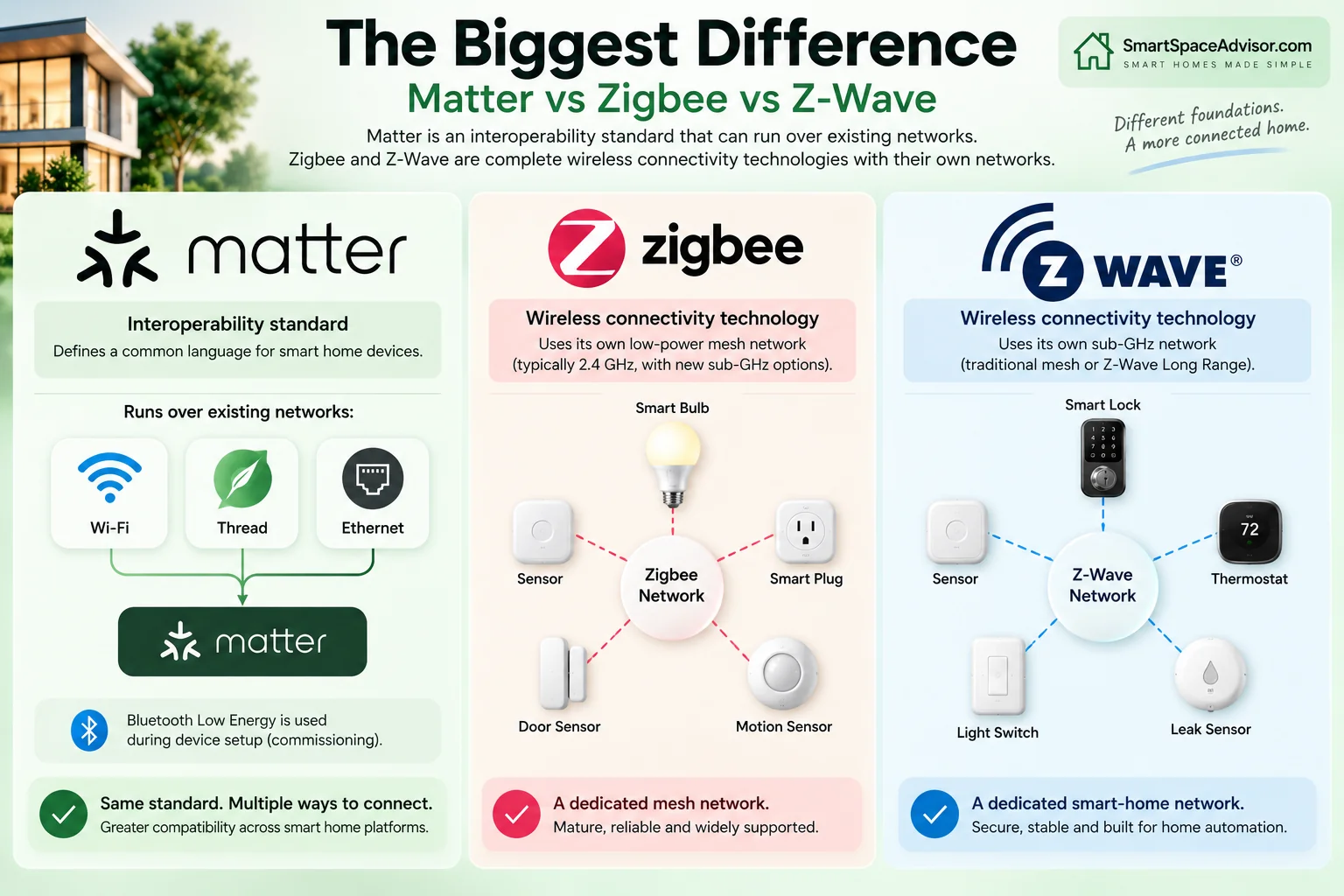
Imagine the smart home as a conversation.
Matter helps define the common language devices use.
Wi-Fi, Thread and Ethernet provide ways for that Matter conversation to travel between devices.
Zigbee and Z-Wave provide their own connectivity stacks and device communication models.
So a product described as:
Matter over Thread
is using Matter for interoperable device communication and Thread as its underlying IP network.
A product described as:
Matter over Wi-Fi
uses Matter while communicating through Wi-Fi.
A Zigbee bulb, by contrast, communicates through a Zigbee network.
A Z-Wave lock communicates through a Z-Wave network.
This is why a technically accurate comparison can’t simply say:
Matter is faster than Zigbee.
or:
Matter has better range than Z-Wave.
Matter itself doesn’t determine those characteristics. The underlying transport matters.
Matter vs Zigbee vs Z-Wave: Do You Need a Hub?
This is another area where oversimplified advice causes confusion.
Does Matter Need a Hub?
Sometimes.
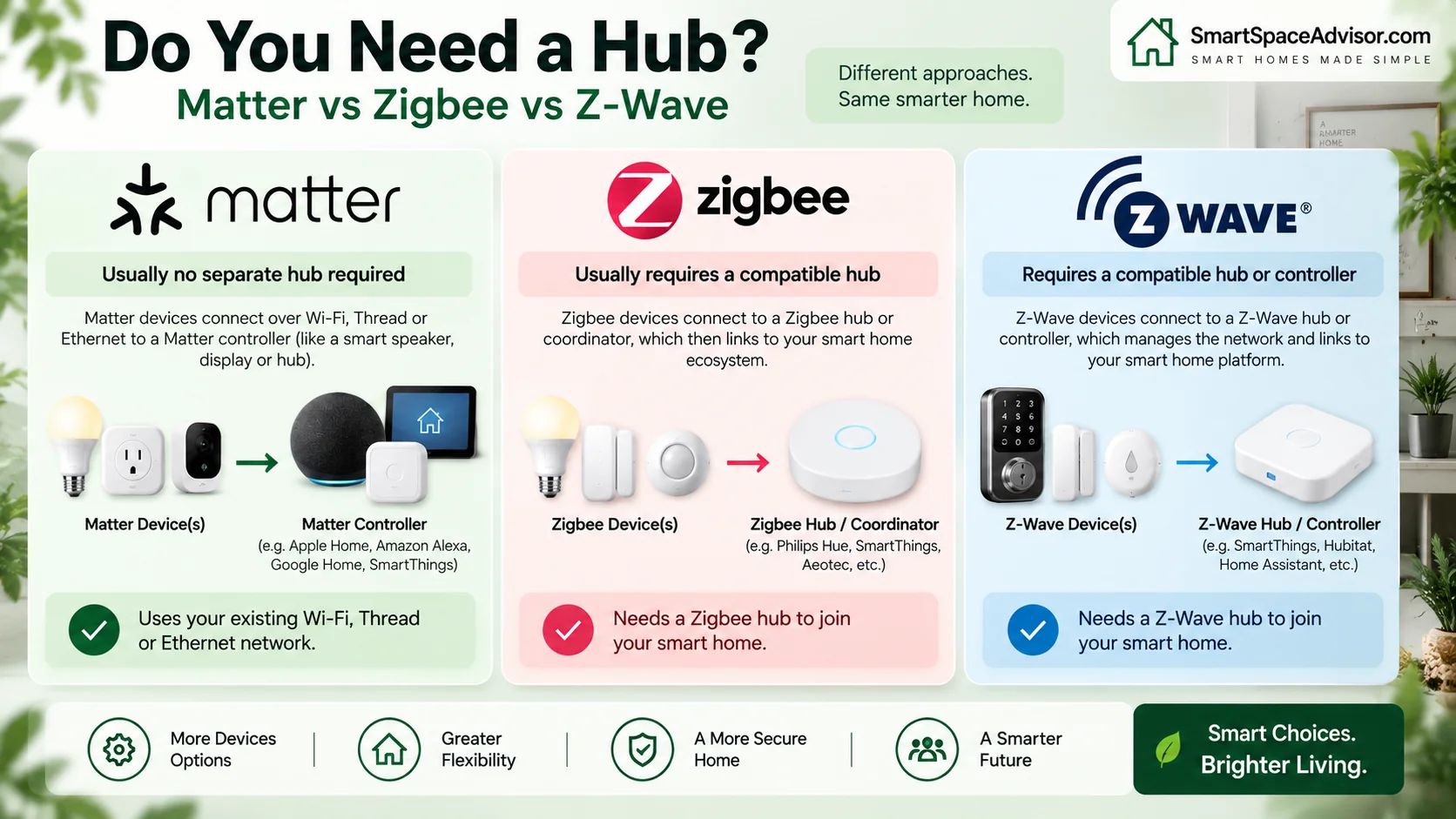
A Matter device needs a Matter controller belonging to the ecosystem you want to use.
Matter controllers can be built into smart speakers, displays, hubs and other devices. Some newer smart speakers also combine Matter controller and Thread Border Router capabilities, which is worth considering when choosing the hub of your smart home. You can see an example in our Echo Dot Max vs Google Home Speaker comparison.
If the Matter device uses Thread, your home also needs access to a Thread Border Router.
A Thread Border Router connects the Thread network to other IP networks such as Wi-Fi or Ethernet.
One physical device can sometimes perform multiple roles, so this doesn’t necessarily mean buying several separate boxes.
Matter-over-Wi-Fi devices don’t require a Thread Border Router.
Does Zigbee Need a Hub?
In typical smart-home installations, yes.
A Zigbee network needs a coordinator, which is commonly built into a smart-home hub, bridge or another compatible device.
Examples of product ecosystems may use their own Zigbee bridge or expose Zigbee support through a multi-protocol hub.
Does Z-Wave Need a Hub?
Typically, yes.
Z-Wave devices generally connect to a compatible Z-Wave controller or hub that manages the network and exposes devices to the user’s smart-home platform.
So the claim that “Matter is hub-free while Zigbee and Z-Wave require hubs” is misleading.
The hardware requirements depend on the specific Matter device and the smart-home platform you’re using.
Matter vs Zigbee vs Z-Wave: Compatibility
Matter
Cross-platform interoperability is Matter’s biggest attraction.
The standard is supported by major smart-home ecosystems, and compatible Matter devices are designed to work across Matter-enabled platforms.
But that does not mean every Matter device exposes every possible feature in every ecosystem.
Device type support, optional features, platform implementation and manufacturer-specific functionality can still differ.
Matter improves interoperability; it doesn’t make every smart-home platform identical.
Zigbee
Zigbee has a large and mature device ecosystem.
Certified Zigbee products use standardized technology and data models, but the practical experience can still depend on the hub, application profile, device implementation and which features the controlling platform exposes.
For consumers, that means you should still verify that a specific Zigbee device is supported by the hub or ecosystem you plan to use.
Z-Wave
Certification has historically been one of Z-Wave’s defining strengths.
The Z-Wave Alliance says certification is designed to ensure interoperability between certified products regardless of brand, while maintaining backwards compatibility between versions.
You still need a compatible controller and should verify regional frequency compatibility, but Z-Wave’s certification model is a significant advantage for dedicated automation systems.
Compatibility winner for broad mainstream ecosystems: Matter
Compatibility strength within a certified dedicated ecosystem: Z-Wave
Compatibility strength for mature low-power device selection: Zigbee
Matter vs Zigbee vs Z-Wave: Range
There is no honest single number for Matter range because Matter can operate over different networks.
Matter Range
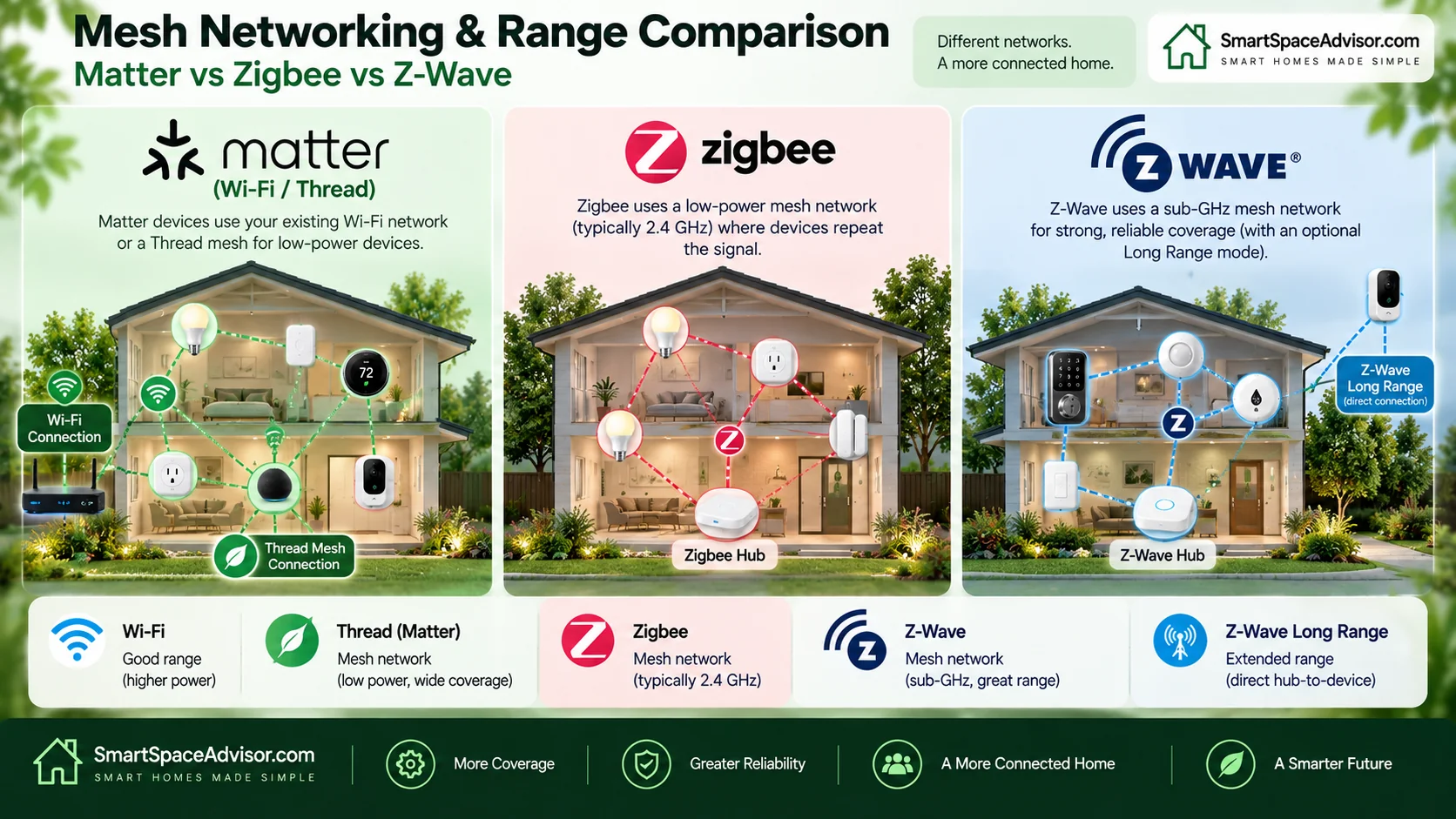
For Matter-over-Wi-Fi, range largely depends on your Wi-Fi network.
For Matter-over-Thread, range depends on the Thread mesh and placement of participating devices and border routers.
Therefore:
“Matter has a range of X feet”
is not a meaningful universal specification.
Zigbee Range
Zigbee’s practical range depends on the device, radio environment, building materials, power levels and mesh topology.
Its major advantage is mesh networking.
Strategically placed powered Zigbee devices can help extend coverage across a home.
Z-Wave Range
Traditional Z-Wave also uses mesh networking.
Its sub-GHz operation can be advantageous in environments where the 2.4 GHz spectrum is crowded.
Z-Wave Long Range goes considerably further by allowing direct long-range connections between compatible devices and the hub. Silicon Labs lists traditional Z-Wave at up to about 100 meters under specified conditions, while Z-Wave Long Range is designed for substantially greater distances.
Range winner: It depends on the implementation, but Z-Wave Long Range has the clearest advantage when very long direct wireless range is the priority.
Matter vs Zigbee vs Z-Wave: Mesh Networking
All three names get associated with mesh networking, but again there is an important distinction.
Matter
Matter itself isn’t a mesh radio technology.
Matter-over-Thread can use Thread’s mesh networking.
Matter-over-Wi-Fi uses your Wi-Fi network instead.
Zigbee
Mesh networking is a core Zigbee strength.
The CSA describes Zigbee as using a self-organizing, self-healing mesh topology capable of scaling to large networks.
Z-Wave
Traditional Z-Wave supports mesh networking.
However, Z-Wave Long Range uses a star topology, with compatible devices communicating directly with the hub.
So saying “Z-Wave is always mesh” is no longer technically accurate.
Which Is Best for Battery-Powered Devices?
All three can work well for battery-powered devices, but the implementation matters.
Matter-over-Thread is specifically attractive for low-power devices because Thread was designed as a low-power IPv6 mesh technology.
Zigbee has an extremely long history in battery-operated sensors, buttons and other low-power devices.
Z-Wave is also designed for low-power smart-home applications, and modern Z-Wave Long Range specifically targets battery efficiency alongside greater range.
For something such as a contact sensor that needs to operate for long periods without frequent battery changes, Thread, Zigbee and Z-Wave are generally more appropriate networking approaches than relying on a conventional always-active Wi-Fi connection.
There isn’t a universal battery-life winner because actual life depends heavily on the product’s hardware, reporting frequency, signal conditions, firmware and battery capacity.
Matter vs Zigbee vs Z-Wave: Speed
For typical smart-home commands, raw bandwidth isn’t usually the deciding factor.
Turning on a bulb or reporting that a door opened requires very little data.
Matter-over-Wi-Fi can use the high bandwidth available from Wi-Fi, which becomes particularly relevant for richer device categories.
Matter 1.5, for example, introduced standardized camera capabilities and added full TCP transport support for larger data transfers.
Zigbee and Z-Wave are optimized more around low-power control and sensor communication than high-bandwidth applications.
That isn’t a weakness when the device is a motion sensor or smart lock.
It is simply a different design goal.
Best for high-bandwidth Matter applications: Matter over suitable IP networking such as Wi-Fi/Ethernet.
For ordinary sensors and controls: raw speed should rarely determine your choice.
Matter vs Zigbee vs Z-Wave: Reliability
Reliability depends on much more than the logo printed on the box.
Network design, interference, hub quality, firmware, device placement and signal strength all matter.
Matter Reliability
Matter can enable local IP-based communication, reducing the need for every routine action to make a round trip through a manufacturer’s cloud.
But reliability still depends on the underlying network.
Poor Wi-Fi can affect Matter-over-Wi-Fi.
A poorly designed Thread network can affect Matter-over-Thread.
Zigbee Reliability
A healthy Zigbee mesh can be extremely reliable.
Adding appropriately placed powered routing devices can improve coverage, but poor channel planning or heavy 2.4 GHz congestion can affect performance.
Z-Wave Reliability
Sub-GHz operation gives traditional Z-Wave separation from the crowded 2.4 GHz spectrum used by conventional Wi-Fi, Bluetooth and many Zigbee networks.
Its mature certification and dedicated smart-home focus are also reasons Z-Wave remains popular in serious automation and security-oriented installations.
Reliability winner: No universal winner.
A well-designed network using any of these technologies can outperform a badly configured network using another.
Matter vs Zigbee vs Z-Wave: Wi-Fi Interference
This comparison requires nuance.
Matter
Matter-over-Wi-Fi obviously uses Wi-Fi.
Matter-over-Thread commonly uses the 2.4 GHz IEEE 802.15.4 spectrum, so radio coexistence still matters.
Zigbee
Traditional consumer Zigbee commonly operates at 2.4 GHz, where it shares spectrum with Wi-Fi and Bluetooth.
Good channel selection can reduce interference.
Zigbee now also has sub-GHz capabilities, so describing all Zigbee as exclusively 2.4 GHz is no longer accurate.
Z-Wave
Traditional Z-Wave operates below 1 GHz and therefore avoids the particular congestion found in the 2.4 GHz band.
Winner for avoiding 2.4 GHz congestion: Z-Wave
Matter vs Zigbee vs Z-Wave: Security
All three modern standards incorporate security mechanisms, but comparing them with a simple “most secure” ranking would be misleading.
Matter was designed with security as a core requirement and uses mechanisms including device authentication, encrypted communications and certification processes. The CSA describes security and privacy as key design tenets of Matter.
Zigbee includes security mechanisms such as AES-128 encryption and authentication, with certification and security requirements continuing to evolve.
Modern Z-Wave also uses strong security mechanisms, including AES-128-based protections, with certification playing an important role in the ecosystem.
For consumers, the protocol is only part of the security picture.
Also consider:
- manufacturer update policies
- account security
- cloud-service security
- router security
- default passwords
- firmware support
- whether devices receive security updates
Security winner: Tie at the protocol-comparison level.
I’d choose well-supported, certified products rather than selecting a protocol based solely on marketing claims about security.
Can Matter Work With Existing Zigbee Devices?
Yes — through a compatible Matter bridge.
Matter does not magically turn an existing Zigbee radio into a native Matter-over-Thread or Matter-over-Wi-Fi device.
Instead, a bridge can translate between the Zigbee network and Matter.
The Connectivity Standards Alliance explicitly supports this architecture, allowing products using technologies such as Zigbee to participate in Matter ecosystems through bridges.
This is especially important for established smart homes.
If you already own a large collection of working Zigbee devices, Matter does not necessarily give you a reason to replace them.
A compatible bridge may allow you to keep using that existing investment while gaining access to Matter-enabled platforms.
Can Matter Work With Z-Wave Devices?
The same general concept applies.
Matter does not natively communicate over the Z-Wave radio protocol.
However, Matter’s bridge architecture can allow a compatible bridge or hub to expose supported Z-Wave devices into a Matter ecosystem. The CSA specifically identifies both Zigbee and Z-Wave as examples of technologies that Matter bridges can connect.
That means the future of the smart home doesn’t necessarily require:
Matter OR Z-Wave.
It can be:
Matter AND Z-Wave.
The same is true for Zigbee.
Should You Replace Zigbee or Z-Wave Devices With Matter?
Usually, no.
If your existing Zigbee or Z-Wave devices:
- work reliably
- receive appropriate support
- integrate with your preferred platform
- perform the automations you need
there is little reason to replace them simply because Matter exists.
Matter’s biggest value is often when you’re buying new devices or connecting ecosystems, not when you’re replacing functioning hardware for the sake of a newer logo.
Bridges are particularly important here because they can allow older protocol ecosystems to coexist with newer Matter-based platforms.
Matter vs Zigbee vs Z-Wave for Smart Lights
For smart lighting, Matter and Zigbee are particularly compelling.
Zigbee has a mature lighting ecosystem and has been widely used in bulbs, switches, remotes and sensors for years.
Matter gives buyers greater flexibility across major smart-home platforms, with products available over Wi-Fi or Thread depending on the device.
Z-Wave lighting devices also exist, particularly switches and dimmers, but its strongest appeal is often in hub-centric whole-home automation rather than inexpensive consumer smart bulbs.
If you’re building your lighting setup on a budget, see our guide to the best smart light bulbs under $20 for affordable options and compatibility considerations.
Our recommendation
For a new mainstream setup:
Choose Matter-compatible lighting when cross-platform flexibility matters most.
For a large hub-based lighting system:
Zigbee remains an excellent option.
Matter vs Zigbee vs Z-Wave for Smart Sensors
This is where Zigbee, Thread-based Matter and Z-Wave all make strong cases.
Sensors typically benefit from:
- low power consumption
- reliable local communication
- good coverage
- fast event reporting
Zigbee has a massive mature sensor ecosystem.
Z-Wave has long been strong in motion, contact, leak and security sensors.
Matter-over-Thread is increasingly attractive for new cross-platform sensors because it combines Matter interoperability with Thread’s low-power IP mesh networking.
Our recommendation
For an existing hub ecosystem, there is no compelling reason to abandon good Zigbee or Z-Wave sensors.
For a new mainstream multi-platform home, Matter-over-Thread is increasingly worth prioritizing when suitable products are available.
Matter vs Zigbee vs Z-Wave for Smart Locks
Smart locks are a particularly interesting category.
Z-Wave has a long-established presence in locks and security-oriented automation.
Zigbee locks also exist.
Matter now supports smart locks as well, allowing compatible products to integrate with Matter ecosystems.
The right choice depends heavily on your controller, security system and preferred ecosystem.
If you’re building around a dedicated automation/security hub, Z-Wave remains highly relevant.
If broad ecosystem interoperability is more important, a well-supported Matter lock may be more attractive.
Matter vs Zigbee vs Z-Wave for a New Smart Home
If you’re setting up a smart home from scratch, choosing the right connectivity technologies is only one part of the process. For a typical new smart home in 2026, I would prioritize Matter compatibility for new purchases — but I wouldn’t restrict the entire house to Matter-only devices. You also don’t need to spend heavily to start experimenting with home automation. Our guide to the best budget smart home devices under $50 includes affordable options for building out a new setup.
Why?
Because Matter’s biggest advantage is flexibility.
It reduces dependence on a single manufacturer’s ecosystem and gives compatible devices a standardized path into major smart-home platforms.
For low-power devices, I’d pay particular attention to Matter-over-Thread products.
But if the best device for a particular job were a reliable Zigbee sensor or Z-Wave lock supported by my hub, I wouldn’t reject it merely because it isn’t native Matter.
The goal should be a reliable smart home, not protocol purity.
Matter vs Zigbee vs Z-Wave for an Existing Smart Home
The recommendation changes if you already own dozens of devices.
If You Already Have Zigbee
Keep your functioning Zigbee devices.
A mature Zigbee mesh can remain an excellent foundation, particularly for lighting and sensors.
Consider adding Matter through a compatible bridge or controller rather than replacing everything.
If You Already Have Z-Wave
The same advice applies.
A stable Z-Wave network containing locks, sensors, switches and thermostats doesn’t suddenly become obsolete because Matter exists.
Use a compatible bridge/hub if you want to connect that ecosystem with Matter platforms.
If You Already Use Multiple Ecosystems
This is where Matter becomes especially interesting.
Matter’s cross-platform focus can make it easier to choose new devices without tying every purchase to one voice assistant or app ecosystem.
Matter vs Zigbee vs Z-Wave: Pros and Cons
Matter Pros
- Designed for cross-platform interoperability
- Backed by major smart-home ecosystems
- IP-based
- Can operate over Wi-Fi, Thread and Ethernet
- Supports multi-admin/multi-ecosystem use cases
- Can incorporate existing Zigbee/Z-Wave ecosystems through bridges
- Continues gaining features through new specification releases
Matter Cons
- Not every platform exposes every device feature identically
- Hardware requirements vary by transport
- Thread devices require access to a Thread Border Router
- Matter certification doesn’t guarantee identical user experiences across ecosystems
- Existing Zigbee/Z-Wave product selection remains stronger in some categories
Zigbee Pros
- Mature technology
- Huge installed base
- Low-power operation
- Self-healing mesh networking
- Strong selection of sensors, lights, switches and accessories
- Continues to evolve rather than being abandoned
Zigbee Cons
- Usually requires a coordinator/hub
- Common 2.4 GHz deployments can face radio congestion
- Practical compatibility can depend on hub and device implementation
- Cross-platform exposure often depends on the hub or bridge
Z-Wave Pros
- Designed specifically around smart-home/IoT control
- Sub-GHz operation avoids 2.4 GHz Wi-Fi congestion
- Strong certification and backwards-compatibility focus
- Mature selection of locks, sensors, switches and automation devices
Z-Wave Cons
- Usually requires a compatible controller/hub
- Regional radio frequencies need consideration
- Smaller overall consumer-device footprint than some competing technologies
- Native support isn’t built into every mainstream smart-home platform
- Z-Wave Long Range requires compatible hardware and shouldn’t be confused with traditional Z-Wave mesh
Matter vs Zigbee vs Z-Wave: Which Should You Choose?
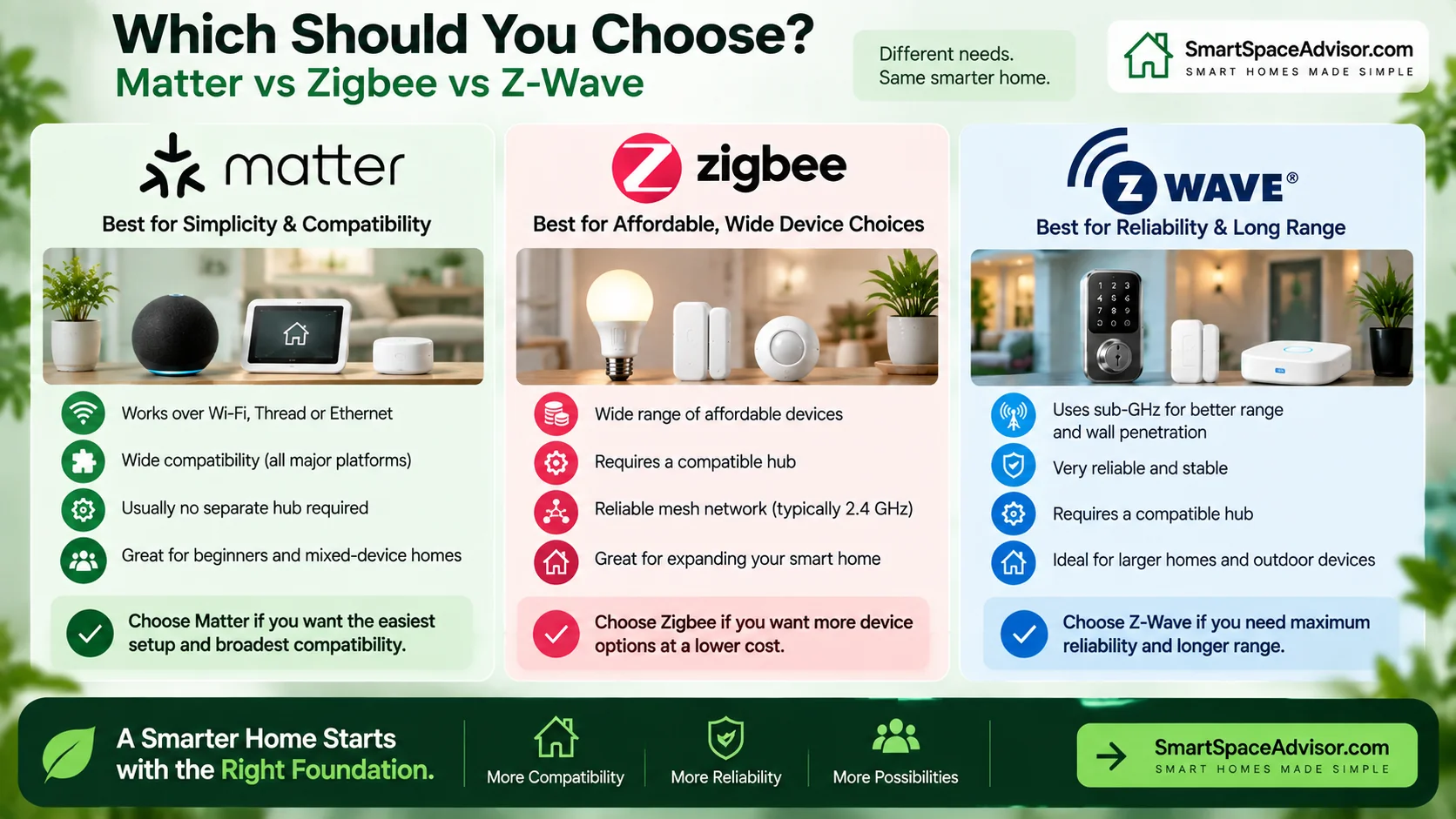
There isn’t one correct answer for every home.
Choose Matter If…
You want the best path toward cross-platform compatibility.
Matter makes particular sense if you’re starting a new smart home, don’t want to be unnecessarily locked into one ecosystem, or expect to use products from multiple brands.
For battery-powered products, Matter-over-Thread is particularly attractive.
Choose Zigbee If…
You want a mature low-power mesh ecosystem with a large selection of sensors, lights, switches and accessories.
It’s especially sensible if you already own a compatible Zigbee hub or have a healthy Zigbee network.
Choose Z-Wave If…
You’re building around a dedicated automation hub or security-focused smart home and value sub-GHz operation, certification, backwards compatibility and strong support for locks, sensors and switches.
Z-Wave Long Range also makes the ecosystem particularly interesting where extended coverage matters.
Choose More Than One If…
This will often be the smartest answer.
A modern smart-home hub may support several technologies, while Matter bridges can connect established Zigbee or Z-Wave devices to Matter ecosystems.
You could therefore have:
Matter-over-Thread sensors
alongside:
Zigbee lighting
and:
Z-Wave locks
without treating the house as three unrelated smart homes.
Matter vs Zigbee vs Z-Wave: Our Verdict
For most people starting a new mainstream smart home in 2026, Matter is the technology I would prioritize when choosing new devices.
But that’s not because Matter has defeated Zigbee and Z-Wave.
It hasn’t.
Matter solves one of the smart home’s biggest historical problems: getting products from different manufacturers and ecosystems to communicate through a common standard.
Zigbee remains one of the most mature low-power mesh technologies available, with a massive installed base and a particularly strong presence in lighting and sensors.
Z-Wave remains highly relevant for dedicated home automation, particularly where sub-GHz operation, certified interoperability, locks, sensors, switches and security applications matter.
So the better question isn’t:
Which protocol should control my entire home?
It’s:
Which technology makes the most sense for each device while keeping the overall home interoperable?
For many households, the best answer in 2026 will be:
Matter for interoperability, with Thread, Zigbee and/or Z-Wave providing connectivity where each makes sense.
Our winners
Best for new mainstream smart homes: Matter
Best for cross-platform compatibility: Matter
Best established low-power mesh ecosystem: Zigbee
Best for avoiding 2.4 GHz congestion: Z-Wave
Best for dedicated hub-based automation: Z-Wave or Zigbee, depending on your device ecosystem
Best approach for advanced smart homes: A well-designed multi-protocol setup
Frequently Asked Questions
Is Matter better than Zigbee?
Not universally. Matter offers stronger cross-platform interoperability, while Zigbee provides a mature low-power mesh ecosystem with an enormous installed base. Matter-over-Thread may be preferable for some new devices, but existing Zigbee systems remain highly useful.
Is Matter replacing Zigbee?
Not in the simple sense. Matter and Zigbee are different technologies, and Zigbee continues to be actively developed. Matter can also incorporate supported Zigbee devices through compatible bridges.
Is Matter replacing Z-Wave?
No. Z-Wave continues to evolve, including through Z-Wave Long Range and updated specifications. Matter bridges can also allow supported Z-Wave devices to participate in Matter ecosystems.
Does Matter use Zigbee?
No. Matter does not natively use Zigbee as its network transport. Matter commonly operates over Wi-Fi, Thread or Ethernet. A Matter bridge can expose supported Zigbee devices to a Matter ecosystem.
Is Thread the same as Matter?
No. Thread is an IP-based low-power mesh networking technology. Matter is an interoperability/application protocol that can run over Thread. Matter can also operate over Wi-Fi and Ethernet.
Does Matter need Wi-Fi?
Not necessarily. Matter can operate over Thread or Ethernet as well as Wi-Fi. However, the broader smart-home system may still use an IP network and Internet connectivity for features such as remote access or cloud services.
Do Matter devices need a hub?
It depends. Matter devices need a compatible Matter controller. Matter-over-Thread devices additionally need access to a Thread Border Router. These functions may already be built into devices such as smart speakers, hubs or routers.
Can Zigbee and Z-Wave work together?
They don’t communicate directly using the same radio protocol, but a multi-protocol hub or software platform can control devices from both networks and combine them in automations.
Can I use Matter, Zigbee and Z-Wave in the same house?
Yes. There is no requirement to choose only one. A multi-protocol smart home can use each technology where it makes sense, provided you have compatible controllers, hubs or bridges.
Which is most future-proof?
Matter currently offers the strongest cross-platform interoperability strategy for new mainstream purchases, but “future-proof” is never guaranteed. Zigbee and Z-Wave both have large installed ecosystems and continue to receive specification and certification updates.
Research & Editorial Approach
This comparison is based on current technical documentation and specifications from the Connectivity Standards Alliance, Z-Wave Alliance, Thread Group and relevant platform documentation.
We distinguish between manufacturer or standards-body specifications and our editorial recommendations. We also avoid presenting maximum theoretical range, interoperability or performance figures as guaranteed real-world results.
Protocol specifications, certification programs and platform compatibility can change over time. Information in this guide was checked in September 2026 and should be verified against the requirements of the specific devices and smart-home platforms you plan to use.

Ryan Hayes
Founder & EditorRyan Hayes is the founder and editor of Smart Space Advisor, where he researches and evaluates smart home technology to help readers make informed buying decisions. His work focuses on smart security, video doorbells, smart plugs, lighting, and connected-home platforms including Matter, Alexa, Google Home, and Apple Home. By combining product research, manufacturer documentation, feature comparisons, and real-world considerations, Ryan aims to cut through technical jargon and provide practical, straightforward advice about which smart home products offer genuine value.